
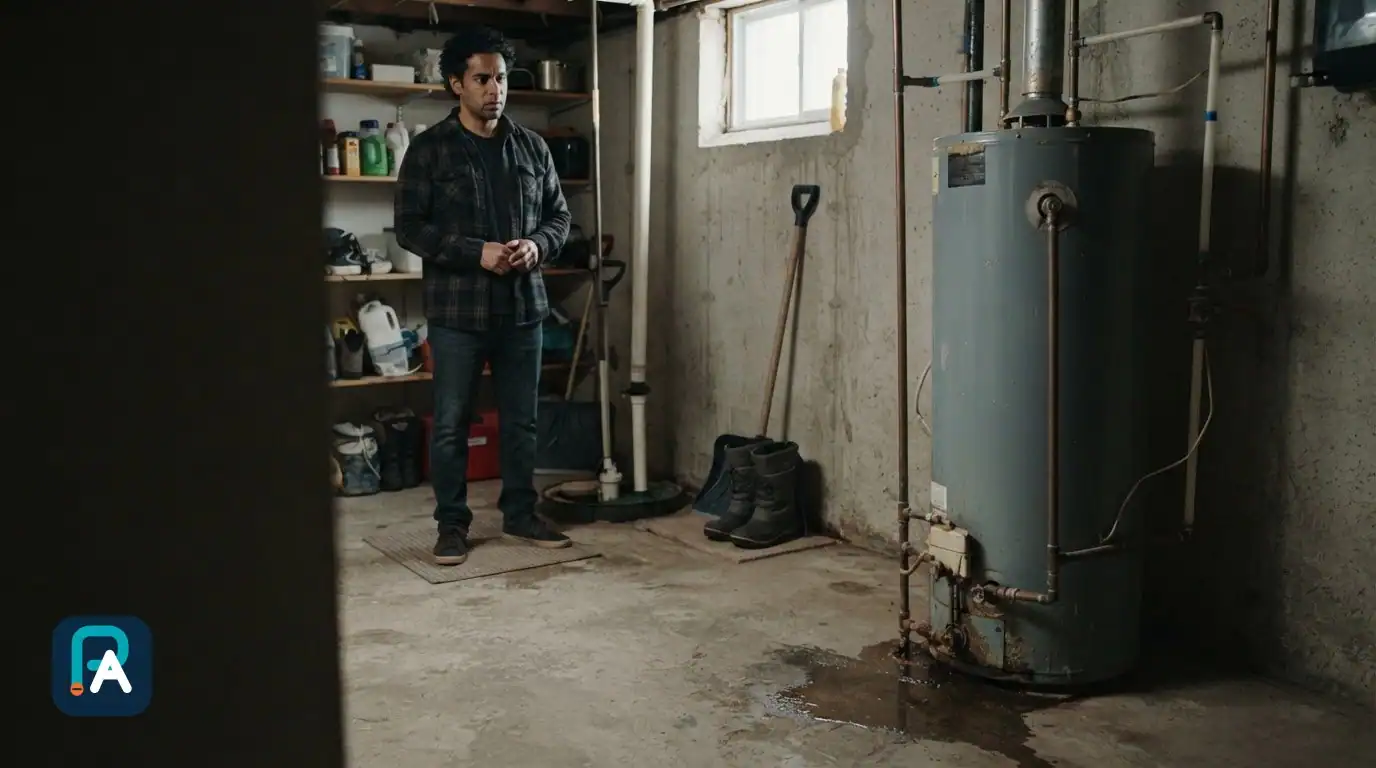
When a water heater leaks, checking its warranty starts with the model, serial number, purchase documents and applicable terms. A warranty that is still in effect does not necessarily make the whole job free: the tank, parts and labour may have different coverage. Warranty paperwork must never delay help for an active leak.
It is easy to remember the large number advertised when you bought the appliance and forget what it covers. However, a promise about the inner tank does not automatically answer a claim involving a component, a connection or installation work. Before concluding that everything is covered, or that the warranty has expired, identify the relevant document and the expense you are asking about.
If water is approaching electrical equipment or access is unsafe, keep your distance. Do not open the appliance to collect evidence or cross a wet area to read its label. You can begin looking through your existing documents from a safe location.
Key takeaways
- The model and serial number help identify the applicable warranty; the brand alone is insufficient.
- Manufacture, purchase and installation dates are different pieces of information.
- Coverage for a leaking inner tank does not automatically include parts and labour.
- A result from a warranty lookup tool is not necessarily an approved claim.
- Maintenance records and written correspondence help establish the facts, but do not replace an assessment of the problem.
- The end of a manufacturer’s warranty does not, by itself, establish that every consumer protection has ended.
Which warranty are you trying to use?
Start by identifying the protection you have. A manufacturer’s certificate, a retailer’s warranty, an installer’s commitment and an additional protection contract are different documents. Several may be relevant to the same situation, but their conditions do not merge simply because they relate to the same water heater.
The Office de la protection du consommateur explains how to have a merchant or manufacturer warranty applied. This process includes requesting repair or authorization to have the item repaired. It should be distinguished from the legal warranties discussed later in this article.
Identify the promise, not just its duration
A statement such as “eight-year warranty” leaves several questions unanswered. Does it concern the inner tank, certain components or several items? Which document sets out the promise? Who provides it? Did the seller offer separate protection for their work? Treat that number as something to investigate, rather than a complete description of what will be paid.
Do not apply the warranty for a similar-looking product to your own appliance. GIANT, for example, publishes different warranty documents for different product families. Two units from the same brand may be governed by different terms. A current product listing also does not establish the conditions that accompanied an older purchase.
Associate each document with the company that issued it and the appliance it concerns. If you have both a manufacturer’s certificate and a separate service agreement, keep them distinct when asking questions. This gives the person reviewing the claim a clear starting point and helps you understand which answer relates to which promise.
How can you identify the appliance without taking it apart?
The model number identifies the product or its variant. The serial number identifies the individual appliance. Copy both accurately, including letters, numbers and suffixes. A capacity expressed in gallons does not replace either identifier, and a brand name does not distinguish one series from another.
Look first at documents you already have: the purchase invoice, installation invoice, certificate supplied with the appliance or an earlier service record. An existing, readable photograph of the rating plate may also avoid an unnecessary approach to the water heater during the incident. Nobody needs to enter a hazardous area simply to complete a form immediately.
Use official lookup tools as a starting point
GIANT’s warranty validation tool uses the serial number and displays tank and parts coverage separately. The manufacturer describes the information as assistance, subject to installation, use and maintenance conditions. It also says proof of installation by a licensed contractor may be required.
Rheem’s Canadian warranty and registration page directs users to its tools and requires the serial number for verification. Use the official site for your brand and the market where the appliance was sold. Information about a different product or another country is not enough to establish your own coverage.
If a number is not recognized, check the transcription before concluding that the appliance is excluded. Confusing a zero with a letter, leaving out a suffix or entering the model in the serial-number field can prevent a useful search. If the lookup still fails, send the available identifiers to customer service and explain which characters remain unclear.
Keep a copy of the response. A lookup result helps organize the inquiry, but the question still needs to connect the particular problem to the applicable terms. Knowing the warranty period and obtaining acceptance of a claim are separate steps.
Which dates determine the coverage period?
A water heater can be manufactured before it is purchased, then installed on another date. An installation invoice may therefore be newer than the manufacturing date without either document being wrong. The applicable warranty determines how those dates are used.
In its Canadian residential warranty for the models listed in the document, A. O. Smith uses the original purchase date or, when proof of that date is unavailable, the manufacturing date. This rule should not be generalized to every manufacturer or series.
Your records should establish a timeline rather than an estimated age. Note the confirmed manufacturing date, purchase date, installation date and date you discovered the problem. If a date comes only from memory, label it as approximate. “Installed around the time we bought the house” is less precise than a dated invoice linked to the appliance.
Apparent age is not the warranty period
Visible rust, the condition of the room and a previous occupant’s recollection do not calculate a warranty date. They cannot replace an identifier or a document. Similarly, an advertisement for water heaters sold today does not establish how much coverage remains on an older unit.
When a lookup result and your invoice appear to give different dates, ask which date was used and what evidence would allow it to be reviewed. That question is more useful than debating how old the tank looks. Keep the result and the documents you submitted together so the comparison can be revisited without starting the search again.
Also distinguish a dated document from its purpose. An invoice for later plumbing work is not necessarily an invoice for the original purchase. Read the description before treating its date as the beginning of the appliance’s warranty.
How can you separate tank, parts and labour coverage?
The phrase “under warranty” needs to refer to a specific item. Tank coverage may provide a replacement appliance, while component coverage may provide a part. Neither statement, on its own, answers who pays for the work associated with that supply.
GIANT’s standard basic residential limited warranty separates the inner tank from component parts and excludes diagnostic, service, removal and reinstallation labour. This illustrates why each section needs to be read. It is not a universal description of every water-heater warranty.
| Item in the claim | Question to clarify |
|---|---|
| Appliance or inner tank | What defect must be confirmed, and what replacement is authorized? |
| Component | Does this part fall within the applicable coverage? |
| Labour | Who authorizes and pays for the service connected with the claim? |
| Related expenses | Which amounts remain payable, and which have a confirmed credit? |
The A. O. Smith warranty linked above also excludes various associated costs, including labour and transportation. A favourable decision about the product can therefore coexist with a bill for other items. Ask for a written explanation of that division instead of assuming that “replacement” means every expense disappears.
Distinguish a confirmed credit from a possible credit
“We will check the warranty” describes an inquiry in progress. “The manufacturer has approved this replacement” describes a more specific decision. If you need to pay something before the response arrives, ask for a clear record of what has been authorized, what remains under review and the conditions for a possible adjustment.
You do not need to establish a market price yourself to understand this distinction. The purpose is to identify the expense, the party responsible and the confirmation supporting that arrangement. An amount described as recoverable should come with clear conditions, so you understand what happens if the claim is later refused.
For example, ask whether a proposed credit concerns the appliance alone or also a particular service charge. An overall verbal assurance leaves that distinction unresolved. A written itemization makes the remaining question easier to follow without turning a pending decision into a promise.
Which documents and conditions can change the answer?
An invoice records a transaction. A certificate describes coverage. A service report records observations and work. These documents complement one another, but none automatically replaces the others. An invoice that says only “water heater,” for instance, may leave you looking elsewhere for the serial number or warranty terms.
Gather the records without changing the history. Keep information about the purchase, installation and earlier service visits. A note saying “maintenance completed” is more useful when it explains what was actually done and identifies the appliance. If you have no evidence for a particular period, say so rather than presenting an assumption as a documented fact.
Check the conditions against the actual use
Warranty certificates may take the purchaser, installation location, use and maintenance into account. The GIANT basic certificate cited above specifies the original purchaser and original installation location and includes maintenance conditions. Report known changes rather than automatically relying on terms described for a different situation.
The fact that a water heater is in an apartment building does not, by itself, determine its contractual classification. Describe its actual use and ask which clause applies. Likewise, a missing maintenance document does not by itself identify the cause of a leak. Ask what evidence is being requested and why it matters to the review.
Do not undertake technical work in an attempt to make the records compliant after the fact. Removing a part, altering the appliance or detaching its rating plate can complicate the assessment and create a hazard. A request for maintenance evidence is a request for information, not an instruction to work on a leaking water heater.
Keep factual gaps visible in the file. If you know when you moved in but not who originally purchased the appliance, those are different facts. Explaining the uncertainty helps the reviewer identify what needs clarification instead of drawing a conclusion from incomplete information.
How can you start a claim without leaving the leak waiting?
Address two needs: getting the present problem under control and having the coverage reviewed. Warranty correspondence may require follow-up, but an active leak should not continue while you search for a receipt or wait for an administrative response.
For an electric appliance, the electric water-heater service page explains how the physical problem can be assessed. Mention the warranty question when arranging help, without assuming that the person attending represents the manufacturer or can authorize reimbursement.
GIANT’s published claim procedure sets out a supplier-based process, written notification within thirty days of discovering the defect, and instructions before disposing of the appliance. That deadline belongs to this procedure. It is not a reason to delay reporting the incident and does not describe every possible remedy.
Clarify what must be kept and who follows up
Before an appliance or part is permanently removed or discarded, ask what evidence the manufacturer requires and who will coordinate its preservation or return. Do not detach the rating plate yourself or move a tank to prepare a shipment. Arrange those requirements with the qualified people handling the work.
Keep written correspondence and the claim reference. Record who received the documents and what response is expected. A specific inquiry can address the certificate being used, the authorization required and the expenses covered. This distinguishes unanswered questions from decisions already made.
If work is necessary before the final decision, have the situation and completed work documented. Ask how the warranty follow-up will continue afterwards. This helps preserve useful information without making the response to a leak depend on the manufacturer’s administrative office being open.
When several people are involved, clarify who is communicating with the manufacturer and who will tell you the outcome. Sending documents to one company does not explain whether another company has received them. A named contact and a reference number help keep the inquiry traceable.
Does an expired warranty or a refusal end every option?
In Québec, manufacturer warranties must be distinguished from legal warranties. The Office de la protection du consommateur explains that legal warranties apply automatically and free of charge. Reasonable durability depends on factors including price, contractual terms and conditions of use; it is not one universal number of years.
This does not mean that a leak automatically entitles you to a new appliance or a full refund. The facts and the protection invoked need to be considered. Ask for the reason for a refusal and the clause relied on, then compare that explanation with your purchase documents. An inapplicable manufacturer warranty is not, by itself, an assessment of every possible right.
For a claim based on legal warranties, the Office says a consumer can contact the merchant, the manufacturer or both. Consult its current guidance to understand the appropriate process. Do not apply a deadline or warranty found on another country’s website to your situation.
Frequently asked questions
Does a replacement supplied under warranty start a new full period?
Not necessarily. The A. O. Smith residential warranty discussed here gives replacement appliances or parts the unexpired portion of the original warranty. Check the wording applicable to your model and keep the document connecting the replacement to the original claim. Do not calculate a fresh full period simply from its delivery date.
What if the retailer that sold the water heater has closed?
Contact the manufacturer to clarify the alternative channel. GIANT’s procedure allows contact with another authorized supplier when the original process cannot be followed. The store’s closure does not, on its own, decide the claim. Keep proof of purchase and explain why the original seller is unavailable.
Is a rented water heater handled like a purchased one?
Do not assume the process is identical. Find the rental agreement and contact the provider named in it to clarify responsibility and authorization. If you occupy the home without holding the contract, inform the person responsible. The logo on the appliance cannot establish how costs are divided.
Can you choose a larger capacity during a warranty exchange?
Approval is not automatically an unrestricted credit for any model you prefer. Ask the supplier which appliance is authorized and whether a change means paying a difference. Confirm the exchange terms before treating a personal preference as an approved supply. Technical selection of the replacement remains a separate question.
Does the water-heater warranty also pay for a damaged floor?
That request needs separate review. The GIANT basic certificate cited here excludes consequential damage from its manufacturer warranty. This clause does not decide your insurance coverage or every remedy available under law. Report the damage to the relevant parties and retain useful evidence without putting yourself at risk.
Get a clear answer about coverage
When a water heater leaks, the useful administrative question is: which document applies to this appliance, this defect and this expense? The model, dates and evidence help obtain a more useful answer than a blanket statement that the unit is covered or not covered.
Have the physical problem addressed, locate the relevant terms and request confirmation of the covered items. You can then continue with a coherent file while avoiding further damage as you research the warranty.