
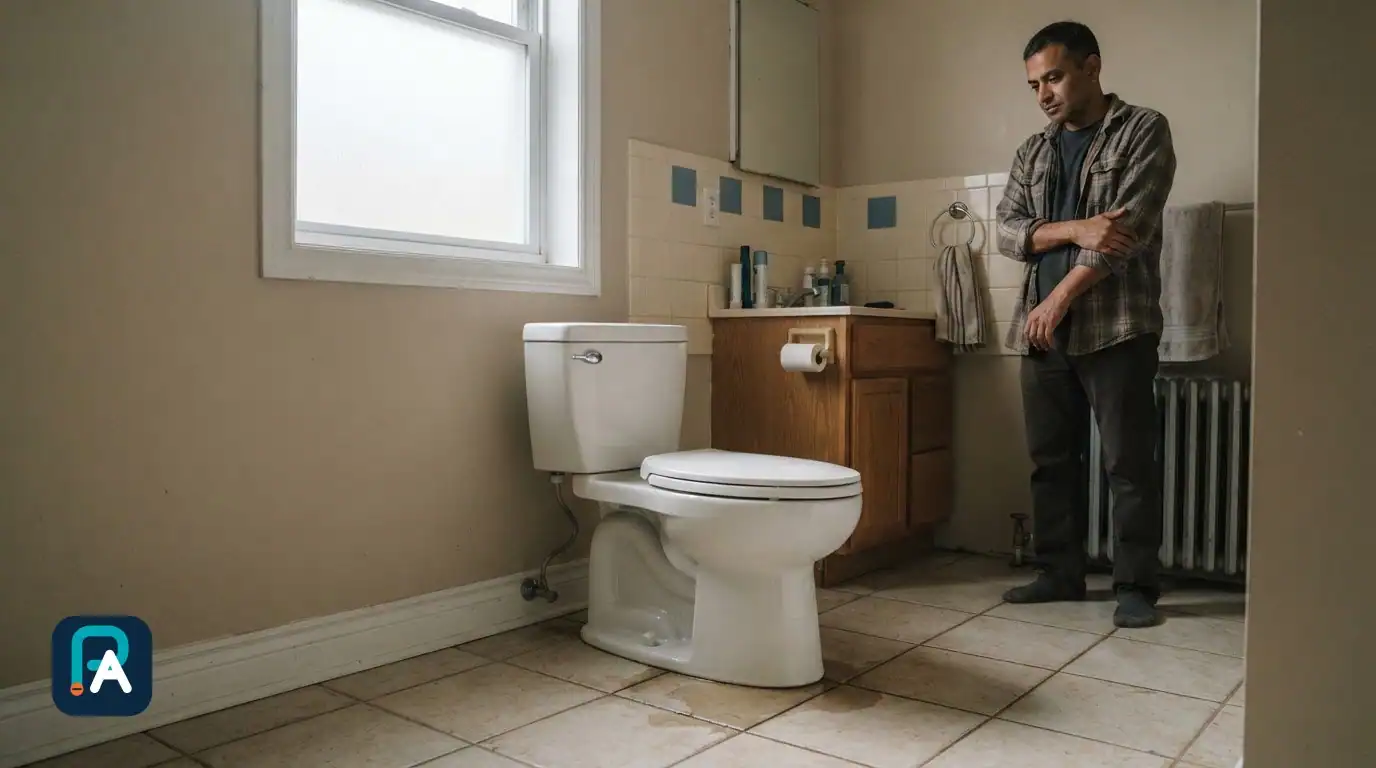
Condensation forms on a toilet tank when moisture in the air meets its sufficiently cold surface. Small droplets can appear on the outside of the porcelain, join together and drip onto the floor. The water is not necessarily passing through the tank. It can come from water vapour already present in the room.
However, this explanation should not be used to classify every puddle near a toilet as condensation. A plumbing leak or splashing can leave water in the same area. The useful distinction starts with where the droplets form, followed by the conditions that favour their appearance.
A damp tank therefore raises two questions: why is water forming on its surface, and does that water actually explain the wet floor? Understanding the process helps you choose an appropriate assessment without taking the toilet apart or assuming that a change to ventilation will solve everything.
Key takeaways
- Condensation forms on the outside of a cold surface. It does not prove that water is passing through the porcelain.
- Room humidity and surface temperature work together. A comfortable bathroom can still contain a tank cold enough for condensation to form.
- Droplets distributed across the tank are consistent with condensation, but they do not rule out a simultaneous leak.
- Repeated flushing brings fresh cold water into the tank and can favour condensation when the surrounding air is humid.
- Reducing moisture production and using existing ventilation are different approaches from repairing a plumbing defect.
- An insulated tank can reduce condensation. It does not correct a mechanical leak or a general humidity problem in the home.
Why does water appear on intact porcelain?
Air contains water vapour even when you cannot see mist. When it meets a sufficiently cold surface, some of that vapour can turn into liquid. It is the same principle as the droplets that appear on the outside of a glass containing a cold drink.
Inside a toilet tank, cold water cools the porcelain. If the surrounding conditions favour condensation, droplets form on the outside. The tank can therefore become wet without being cracked and without its flush mechanism necessarily being faulty.
CMHC’s Moisture and Air guide specifically identifies uninsulated toilet tanks as surfaces that can develop condensation in humid weather. It also distinguishes this condition from plumbing leaks and water introduced through other bathroom activities.
Room temperature alone does not explain the droplets
Saying “it is warm in here” does not mean every surface is warm. The tank wall is influenced by the water inside, while the bathroom air can be warmer and contain moisture. Those two temperatures should not be treated as the same measurement.
The relevant threshold is the dew point: the temperature at which moisture can condense as air is cooled. Environment and Climate Change Canada’s explanation of dew point describes that relationship between cooling and condensation. You do not need to calculate the threshold to report a tank covered in droplets.
There is consequently no single room temperature that guarantees a dry tank in every home. Humidity and cooling of the surface also matter. Raising the bathroom temperature arbitrarily is not, by itself, a complete or necessarily suitable solution.
The distinction is useful because it keeps the question focused on the surface and surrounding air, rather than assuming the room feels comfortable and therefore cannot have a condensation problem.
The water can come from the air rather than inside the toilet
That difference changes the question being investigated. If water forms on the outside wall, the conditions allowing condensation need attention. If it emerges from a particular point, the possibility of a leak requires a different check.
People sometimes use “sweating,” “seeping” and “leaking” interchangeably when describing a wet toilet. To make the situation clearer, describe “small droplets across the tank surface” or “water that appears to start at this point.” You do not need to name a part to explain that distinction.
This description identifies what was seen without converting it into a diagnosis. It also avoids treating a damp surface and water escaping from a connection as though they were automatically the same problem.
Why does the tank become wet at certain times?
A tank may remain dry for part of the day, then develop droplets as conditions change. This behaviour does not automatically establish that a component is failing intermittently. The surface temperature and moisture around it can also vary.
Compare the ordinary circumstances: does the problem occur mainly after bathing, during warm and humid weather, or when several people use the bathroom in succession? There is no need to extend a shower or flush repeatedly to deliberately produce condensation.
Frequent use keeps replenishing the cold water
Each flush replaces some of the water in the tank. Closely spaced uses can therefore keep the surface cold while the surrounding air is humid. CMHC’s Homeowner’s Inspection Checklist discusses condensation caused by very cold water in frequently used toilets and notes the risk to the floor.
A bathroom shared by several occupants can have different conditions from a rarely used powder room. That difference does not justify reducing the tank level arbitrarily or changing its settings. The toilet should continue to operate according to its model’s requirements.
If the tank starts refilling without anyone using the toilet, report that as a separate symptom. It could affect how often cold water is replenished, but it needs its own assessment. Condensation does not identify the cause of abnormal refilling.
The practical point is to keep usage-related cooling and an unusual filling pattern separate. Both can be relevant, but one observation cannot establish the other.
The season provides context, not proof
Droplets returning during humid weather make room conditions a relevant question. That pattern does not confirm that the tank and connections are watertight. Conversely, droplets in winter do not make condensation impossible: bathroom activities and a cold surface can still create suitable conditions.
Avoid turning a seasonal pattern into a permanent excuse. “It happens every summer” describes repetition. It does not establish whether the floor has been receiving water for several seasons or whether a leak has since developed as well.
A change also deserves attention in its own right. If the amount of water appears clearly different from what was usual, do not assume that an earlier explanation automatically covers the new situation.
The season helps explain the context of an observation. It should not replace an assessment when the behaviour or consequences change.
What can you compare without taking the toilet apart?
The purpose is not to test connections for leaks. It is to distinguish water forming on a surface from water whose starting point has not been observed. Look at visible areas from a stable position without moving the fixture or squeezing behind it.
Small droplets spread across a broad area of the tank are one appearance consistent with condensation. A localized trail starting beneath a connection or at a joint raises a different question. These observations can help direct an assessment, but they do not replace a plumbing check.
The tank surface and the floor provide different information
Seeing droplets form on the porcelain tells you something about that surface. Finding a puddle on the floor afterward tells you much less about where it came from. Water may have travelled before becoming visible near the base.
Do not trace it backward in your mind simply by choosing the nearest fixture. Water in front of the toilet can also come from another bathroom activity. A photograph of a wet floor cannot, on its own, establish condensation as the cause.
If water appears to come from the base, the toilet rocks or the source remains uncertain, stop using it until it can be assessed appropriately. The plumbing fixtures and toilet service page addresses those separate plumbing situations.
Two problems can exist at the same time
A tank can develop condensation while another part of the toilet leaks. Finding droplets does not therefore close the investigation. Likewise, fewer droplets after the fan has been used do not establish that all the water on the floor came from the tank surface.
The useful question is whether the observed process adequately explains the water that keeps appearing. If the tank becomes dry but the floor is regularly wet, reconsider the explanation rather than adding more measures aimed solely at humidity.
The reverse is also true: identifying a leak does not prevent condensation from being present. Each water source needs a response suited to it. Giving the entire bathroom one label can leave part of the problem unresolved.
You do not need to investigate both causes yourself. The important step is to preserve the distinction so that one explanation is not used to dismiss another concern.
Which habits can reduce condensation?
When condensation has been properly identified, the first approach is to reduce moisture available around the cold surface. Start with normal bathroom activities before modifying the toilet itself.
The Québec government recommends using exhaust fans during bathing and showering and limiting frequent long showers. These measures concern indoor moisture management. They do not repair a leaking connection or correct a drainage problem.
Use extraction rather than relying on the sound of a fan
Use the existing exhaust fan during activities that generate moisture and follow its operating instructions. Hearing a fan run does not, by itself, confirm that humid air is being discharged properly outdoors.
If significant condensation persists despite appropriate use, have the ventilation assessed by the relevant professional. The outlet, duct and operating conditions may need examination. Do not open a ceiling or climb into an attic to trace the duct yourself.
There is no need to impose one identical operating duration on every bathroom. The room, activities and equipment all matter. A technical correction should follow an understanding of what is actually limiting moisture removal.
The intended result is effective extraction, rather than simply more time spent listening to a motor that may or may not be moving air as required.
Avoid adding another moisture source beside the tank
Soaked towels and laundry hung to dry contribute moisture to the room. Avoid accumulating wet textiles around the toilet and keep the airflow routes intended for the installation available.
This adjustment should not become a way to absorb water indefinitely. A mat or towel that is constantly wet can conceal how often the problem returns. The useful outcome is less water being introduced and a clear understanding of its source, rather than a floor that merely looks drier because a textile covers it.
Before adding dehumidifying equipment, distinguish an episode associated with bathroom use from humidity affecting several rooms. A purchase does not replace that distinction and does not resolve a possible leak.
The question is which condition needs correction. Buying equipment first can leave you managing the visible water while its cause remains unclear.
What does an insulated toilet tank do?
An insulated tank has an internal lining intended to reduce the cooling effect of the water on its exterior surface. Its purpose is to limit condensation under the conditions for which it was designed. This feature is different from flush volume or the shape of the bowl.
For example, American Standard’s Canadian specification page for the lined Colony 3 tank expressly describes its lining as helping prevent exterior condensation. This illustrates a technical feature; it is not a recommendation to purchase that model for your installation.
Thermal protection does not repair a leak
Insulation does not replace the watertightness of the porcelain or connections. It also does not correct a toilet that keeps running. Before attributing all moisture to the present tank, ask which water source the proposed equipment is intended to address.
A feature advertised as reducing condensation should not be interpreted as a guarantee that the floor will always stay dry. Room conditions still matter, and other water sources need separate consideration.
If adding insulation to an existing tank is being considered, have its suitability checked for that particular model. Do not glue arbitrary foam around the mechanisms. This guide does not provide instructions for changing flush components or improvising a tank modification.
Evaluate a correction rather than choosing a toilet on this feature alone
The first question is whether condensation actually explains the water and whether room conditions have been considered. A wet surface does not automatically make replacing the fixture the first solution.
The appropriate decision may concern room humidity, ventilation, a plumbing assessment or a feature of the equipment. These options are not interchangeable. A clear explanation of the expected correction helps prevent a product being selected to solve a problem it does not address.
It is reasonable to ask what improvement is expected and what would remain outside that improvement. That keeps the decision tied to the identified condition rather than a broad promise about bathroom moisture.
Why does a repeatedly wet floor need attention?
Water from condensation may seem less concerning than a pipe leak. Nevertheless, repeated wetting in the same area is still a moisture issue for surrounding materials. A physical rather than mechanical origin does not make a constantly wet floor acceptable.
CMHC’s inspection guide, cited above, highlights that risk for a frequently used toilet. The decision therefore depends on more than the name assigned to the process. Its repetition and effects around the fixture also matter.
Avoid hiding the area beneath a new floor covering or stored items before the water source has been understood. A persistent odour, visible deterioration or support that appears to be losing stability warrants an assessment of the building and relevant installation.
Stop comparing droplets if doing so requires entering an unsafe area, touching wet electrical equipment or handling plumbing connections. When the water’s source is unknown, do not assume it is clean simply because it looks clear.
The useful approach is proportionate: understand the droplets on the tank, have water of uncertain origin assessed and correct the conditions identified. Condensation is a possibility to understand, not a conclusion to apply automatically to every puddle near a toilet.
Frequently asked questions
Why does only one toilet develop condensation?
Conditions are not necessarily the same in every room. Local humidity, use, water temperature and tank features can differ. A powder room without a shower and a frequently used bathroom do not have the same environment. That difference does not prove the damp toilet is defective; it suggests comparing the conditions before choosing a correction.
Can a one-piece toilet develop condensation too?
The fixture’s shape does not remove the physical process. A sufficiently cold surface can develop condensation in humid air, depending on the design and room conditions. Do not assume a toilet has condensation protection simply because there is no visible joint between the bowl and tank. Check the model’s features rather than relying on its overall appearance.
Is opening the window enough to solve the problem?
Not necessarily. The result depends on outdoor conditions and the air exchange obtained. An open window does not automatically replace effective extraction, particularly when outdoor air is humid too. Use the ventilation intended for the room and have its performance assessed if the problem persists, rather than treating an open window as a guaranteed solution.
Can you fill the tank with hot water to prevent droplets?
Do not improvise this approach or modify the toilet’s water supply. Any solution intended to change the water temperature needs assessment for the installation and its components by a qualified professional. Pouring hot water into the tank is not an approved treatment in this guide and does not correct the bathroom’s humidity conditions.
Does a tank cover replace an internal insulating liner?
Do not assume they are equivalent. An exterior decorative cover does not establish a thermal performance specified by the manufacturer. It can also make the tank surface and some water trails harder to see. If you use one, do not let its appearance replace observation of the fixture. A cover that repeatedly becomes wet means the source still needs understanding.
If the tank is dry today, is the problem resolved?
A dry day can simply reflect different conditions. A correction needs to be considered under the circumstances in which droplets normally appeared, without deliberately recreating an episode. If water continues to appear on the floor despite a dry tank surface, have its source reassessed. A temporary absence of droplets confirms neither the toilet’s watertightness nor the absence of moisture around its base.