
No hot water
The breaker, power supply, thermostats, elements and safety devices may need to be checked. Electrical work must be handled by an appropriately qualified person.
Installation · Repair · Replacement · 24/7 service
Need an electric water heater installation, a water heater repair after a failure, or a planned water heater replacement We assess the leak, capacity, access and connections first so the appropriate service can be scheduled.
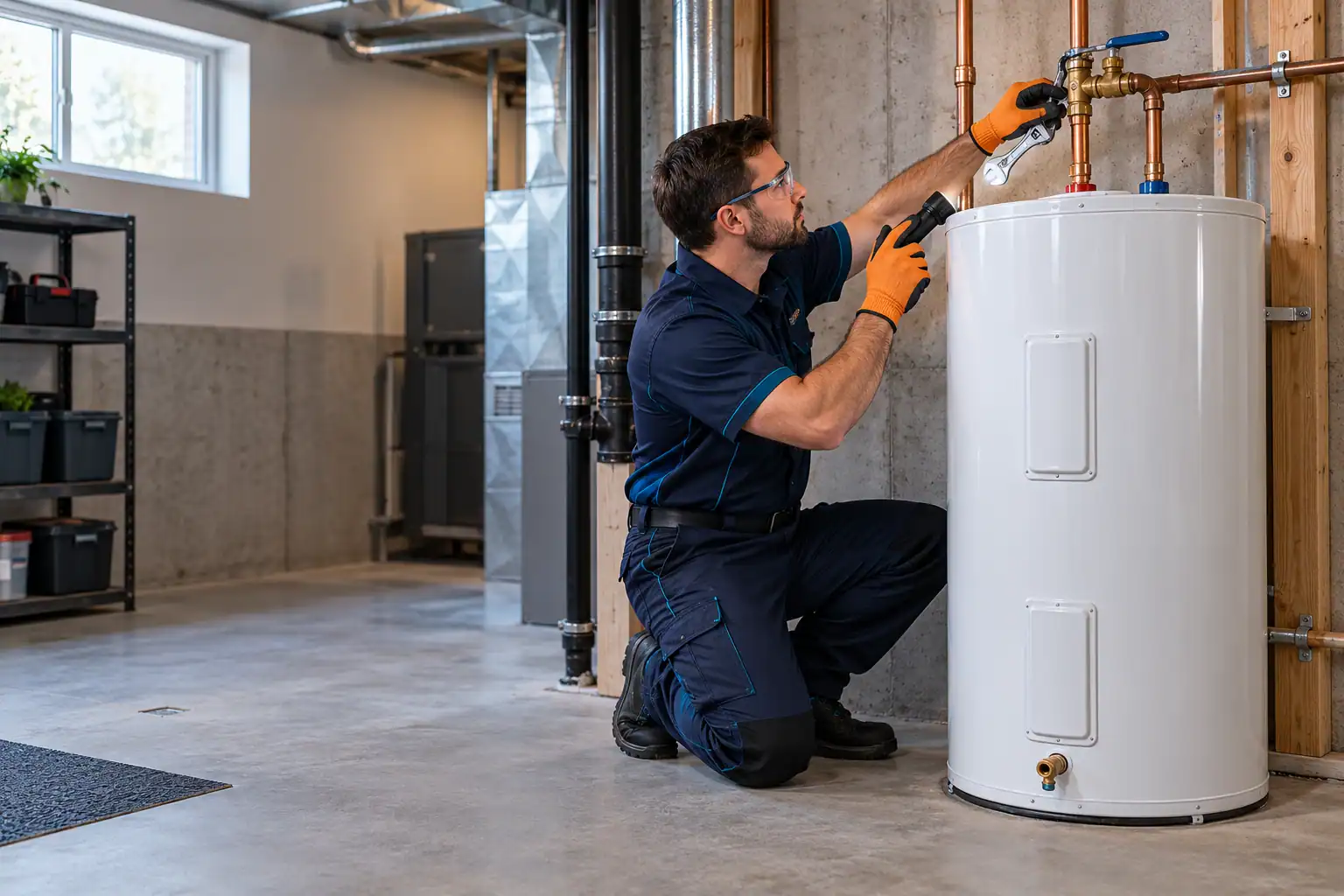
Leaking water heater
A leak can come from a connection, the temperature and pressure relief valve, the drain valve or the tank. Its source completely changes the decision. A perforated tank cannot be repaired reliably, so water heater replacement is normally required.
Do not walk through water to reach the panel, water heater or an outlet.
Use the breaker identified for the water heater. If you are unsure, do not touch it.
The cold-water shutoff is usually on the upper supply pipe. Do not force a seized valve.
Tell us whether the water is coming from above, a valve, the bottom of the tank or a visible connection.
Repair or replace
A water heater repair may be suitable for certain connections or replaceable components. A leaking tank, advanced corrosion or multiple failures may make replacement the more sensible option.
The breaker, power supply, thermostats, elements and safety devices may need to be checked. Electrical work must be handled by an appropriately qualified person.
A failed element, a setting, high demand or an undersized tank can produce similar symptoms.
Depending on its condition, an upper connection, valve or joint can sometimes be repaired without replacing the entire tank.
A leak through the tank or near its base usually indicates that the tank has lost its integrity.
Temperature, pressure, expansion or a defective valve are possible causes. Never cap its discharge pipe.
Sediment, material expansion or an operating component can create different sounds. The source must be confirmed.
Identify the problem correctly
Locating the moisture helps avoid condemning the tank too quickly. If it is safe, dry the area and observe where the water returns without removing any panels.
Do not remove electrical panels and never disable the relief valve.
Choosing capacity
Household size helps, but it is not enough. Baths, long showers, back-to-back schedules, the washing machine, dishwasher and recovery rate all affect real-world comfort.
May be suitable when simultaneous demand is limited, space is tight and routines are predictable.
May better suit larger or closely spaced demand peaks if access, space and the existing installation are compatible.
Water heater installation
The new unit must fit through the access path, the old tank must be removed, and the connections and safety discharge must be adapted. Replacement involves more than choosing a capacity from a label.
Have the installation assessed →Dimensions, rating, warranty, household demand and compatibility with the existing installation.
Stairs, doors, turns, ceiling height, panel clearance and the route for removing the old tank.
Shut off the supplies, control the drainage and protect surfaces during handling.
Cold inlet, hot outlet, shutoff valve, relief valve, discharge piping and drain pan when required by the configuration.
The tank must be full and purged of air before power is supplied to the heating elements.
Check the connections, operation and safety discharge, then explain the relevant instructions to the owner.
Plumbing requirement
The RBQ specifies that replacing a storage water heater in an existing building must comply with the Construction Code. Among other requirements, the relief-valve discharge pipe must point downward and discharge indirectly to a permitted destination for the configuration.
It must not be capped, arbitrarily reduced or directed where discharge would create a hazard. The correct solution depends on the floor drain, pit, pan and existing connections.
Read the RBQ technical directive (French) ↗The cold-water supply must be isolatable without forcing an inaccessible or damaged valve.
The temperature and pressure relief valve remains an essential safety device.
The pipe route and discharge point must suit the actual installation.
The circuit, breaker and electrical work are subject to the applicable requirements and qualifications.
STORAGE TEMPERATURE
Temperature and safety
Québec public-health guidance recommends storing water at 60 °C to limit Legionella growth. Scalding risk should instead be controlled with the appropriate devices near points of use, according to the applicable requirements.
Do not adjust thermostats or anti-scald devices at random. Have the system checked if the water is excessively hot, not hot enough or inconsistent.
Water heater installation cost
The cost of a water heater installation or replacement does not depend only on a 40- or 60-gallon capacity. The photos and details below help establish the actual scope instead of relying on an incomplete number.
Capacity, technology, warranty, dimensions, rating and model availability.
Floor, stairs, turns, door width and surface protection.
Pipe position, shutoff valve, relief valve, discharge route and required modifications.
Condition of the old tank, drain valve, removal route and disposal of the unit.
Floor configuration, proximity to a floor drain and the compliant solution required.
A circuit or electrical-connection change may require separate coordination.
Send a full photo of the water heater, its rating plate, the upper connections, the surrounding floor and the access route.
Anjou and Greater Montreal
Plomberie Anjou handles requests for electric water heater installation, a leak, a plumbing diagnosis or a planned hot water tank replacement in Anjou and the service areas presented on this site.
For a condo or multi-unit building, specify access rules, the floor, elevator availability, permitted hours and the location of the main shutoff. These details can affect handling and coordination.
Describe the building and unit →Official resources
These resources explain hot-water use, safe temperature, relief-valve function and requirements related to replacement.
Water heating represents a significant share of household electricity use.
View energy-saving advice ↗Technical directive on relief-valve discharge and permitted destinations for the installation.
Read the directive (French) ↗Public-health guidance on hot-water systems, storage temperature and scalding prevention.
Read the recommendation ↗The public repertory can be used to confirm the licence holder and associated subclasses.
Check an RBQ licence ↗Customer experiences
Read experiences published by customers. The diagnosis, capacity, access and connections remain specific to each water heater.
View the Google profile ↗Frequently asked questions
The precise answer depends on the model, the source of the problem and the existing installation.
Speak with a plumberSometimes. The power supply, thermostats, elements and safety devices must be checked. Plumbing and electrical work can require different qualifications.
Not when the leak comes from a connection or replaceable part and the tank remains sound. A leak from the tank itself generally leads to replacement.
Consider peak use, the number and duration of showers, baths, appliances, available space, electrical rating and the model’s recovery rate.
The model, capacity, access, removal, connections, discharge arrangement and related work affect the price. Photos and the rating plate help define the scope.
An element, thermostat, increased demand, sediment or insufficient capacity can cause this symptom. A diagnosis helps avoid replacing the tank without reason.
Québec public-health guidance recommends a storage temperature of 60 °C to limit Legionella growth. Appropriate devices at points of use are used to manage scalding risk.
Electrical work must be performed by a person holding the applicable qualifications. Mention any planned rating, circuit or panel change when you call.
Not necessarily. Confirming capacity, dimensions, rating, access and connections before purchase reduces the risk of choosing an incompatible unit.
Stay away from water near electrical equipment, turn off power only if access is dry and safe, close the water supply if possible and call 514 312-1521.
Water heater installation, repair or replacement
Prepare the address, capacity, a photo of the rating plate, the connections and the access route.