
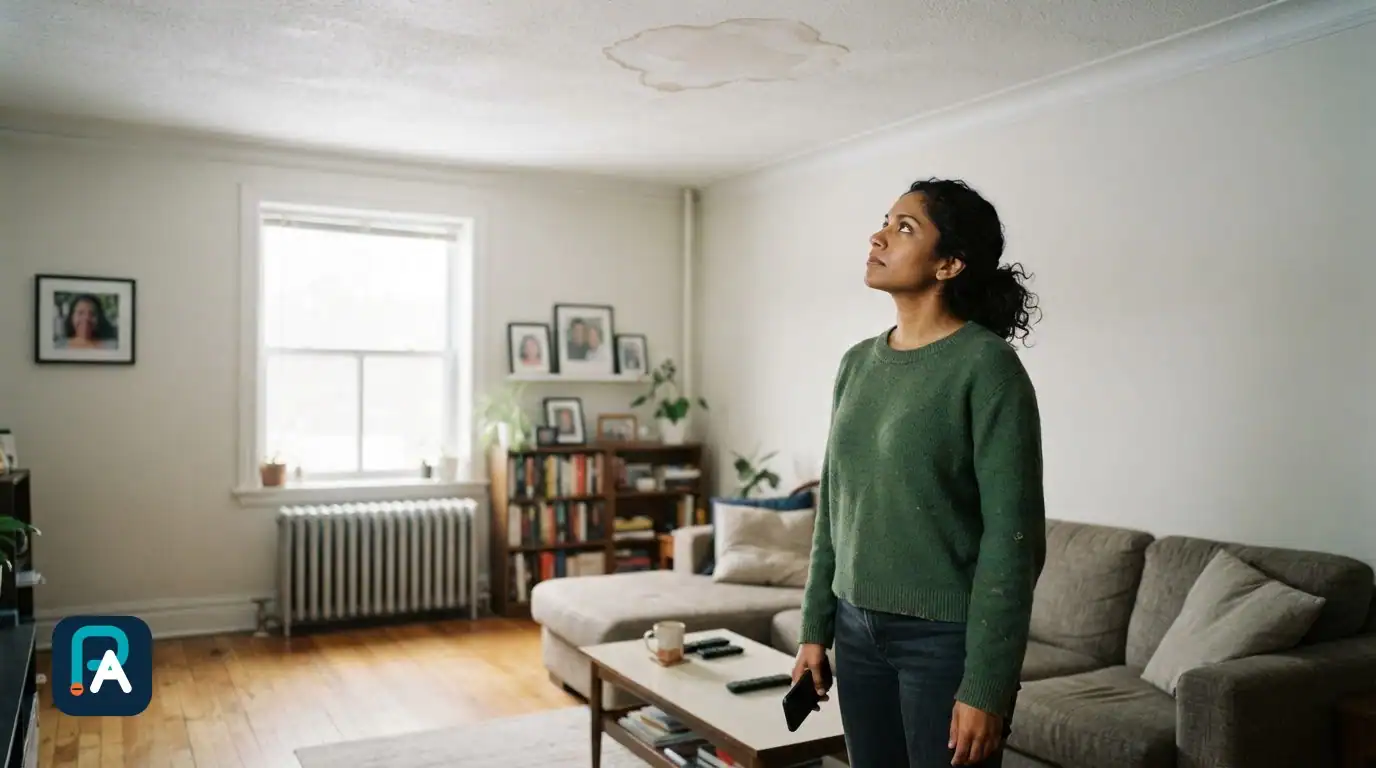
A water stain on the ceiling can suggest a slow leak when it expands, develops a new ring or comes with changes in the paint. Its colour cannot confirm a plumbing leak, how long it has lasted or how much water is escaping. Water entering from outside, condensation and an earlier incident can also leave a mark.
The most useful clue is how the stain changes. A ring discovered today did not necessarily appear today. A mark that looks dry does not explain what is happening behind the finish. Compare observable changes, understand the limits of those observations and have new or recurring moisture assessed before treating the problem as cosmetic.
If the ceiling deforms, sheds material or shows water near a light fixture, keep away from the area. In those circumstances, safety takes priority over comparing photographs.
Key takeaways
- A new edge or an expanding ring tells you more than a brown colour that looks unchanged in an older photograph.
- A slow leak does not necessarily produce visible dripping or a sound you can hear in the room.
- Discolouration, current moisture and a change in the ceiling’s shape are separate observations.
- A connection with rain, the season or activity in a room provides context; it does not establish the cause.
- A hygrometer measures moisture in the air. It cannot confirm that the ceiling materials are dry.
- A stain that returns after repainting needs its moisture source investigated rather than another coat to cover it.
What does a water stain on the ceiling actually reveal?
A water stain is a visible change at the surface. It may look like a yellow ring, a darker patch or a difference in texture. That observation tells you something about the finish, but much less about the installations concealed above it. It does not measure the water that entered the building or show the full extent of the affected materials.
The Québec government identifies stains, buckling and peeling on walls or ceilings as possible signs of a hidden moisture problem. A mark therefore deserves an explanation even without dramatic dripping. It does not, by itself, identify a faulty pipe.
Colour does not date the problem
A dark stain is not automatically newer or more serious than a pale one. Its appearance also depends on the finish, layers of paint and materials the water has passed through. Without a history, you cannot translate a shade of brown into a number of days of leaking. A sharply defined edge is not proof that everything has dried either.
Colour is most useful when you have a reliable comparison. If a previously uniform area now has a new outline, something has changed. If the stain simply looks more yellow in a photograph taken under different lighting, the comparison remains uncertain. Describe that uncertainty instead of concluding that water has returned.
The finish and the material tell different stories
Intact paint does not prove that the material beneath it is dry. Conversely, old peeling paint does not establish that a leak is still active. Note the colour, blisters and changes in shape separately. This avoids turning three different signs into a single diagnosis.
Do not press a blister or scrape the ceiling to decide between these possibilities. An observation from the floor is enough to report an apparent change. Assessing the underlying material requires an approach suited to the ceiling and nearby installations, particularly when the surface appears weakened.
Which changes suggest recent moisture?
A slow leak may become noticeable through repeated effects of moisture rather than water falling into the room. “Slow” describes a possibility about the flow, not a conclusion you can draw from the stain’s size. A small visible mark may be the only clue available. It cannot tell you the flow rate behind the ceiling.
Look for specific changes: an outline extending beyond the one in an older photograph, a second patch appearing beside it, a new blister or a finish that has started to deform since discovery. These observations warrant assessment. They do not yet establish whether the water comes from plumbing, the building exterior or condensation.
An unusual musty smell in the same area is also worth mentioning. It does not measure the amount of water or identify where it entered. Do not bring your face close to a suspect surface to investigate the smell. A persistent odour without an obvious explanation may require an examination of the building.
Distinguish discovering a stain from a change in the stain
Consider two situations. Someone notices a ring after moving furniture, then finds an older photograph showing the same outline. Someone else has a recent photograph of an unmarked ceiling and now sees a stain. The second history establishes a recent change more confidently. The first suggests an existing mark, without guaranteeing that there is no current moisture.
This distinction helps avoid two mistakes: describing a leak as having started “this morning” when only its discovery dates from this morning, or ignoring a new ring because no water is dripping. Record the discovery date separately from the earliest available evidence of a change.
Silence is not a check for leaks
No sound and no dripping are compatible with several situations: an old mark, intermittent moisture or water that has not reached the visible surface as a drip. Their absence does not rule out a problem. Equally, a sound heard inside a partition does not prove that it explains the stain.
A documented change deserves assessment without waiting for something more dramatic. The purpose of observation is to explain what has already changed so the cause can be investigated. It is not to watch until water starts running through the finish.
How can you compare changes without creating a false diagnosis?
Compare photographs taken under reasonably similar conditions. A wider photograph locates the mark in the room; a closer view shows its outline. Keep the angle and lighting similar when you can do so from a safe position. Filters, flash and shadows can make discolouration appear to spread when only the way it is photographed has changed.
Use an existing fixed reference, such as a moulding or the corner of a wall. You can annotate the photograph on your phone to outline the area you observed. There is no need to draw on the ceiling, stick anything to the paint or position a ladder beneath the stain.
A useful note might say: “Ring discovered Tuesday; on Wednesday, a new edge appeared toward the window that was absent from the first photograph.” Another might say: “Outline appears unchanged, but lighting is different; colour change not confirmed.” Both descriptions are useful, even though the observations have limits.
The Société d’habitation du Québec’s inspection guidance on mould, available in French, emphasizes documenting findings, history and the limits of an examination. For an occupant, the practical application is straightforward: preserve the available facts and state honestly what could not be observed.
Keep records of earlier incidents too
If a leak or water-entry problem was previously corrected, look for a document identifying the source and the work completed. An invoice that says only “ceiling painting” does not confirm that the cause of moisture was investigated. An older photograph may also show whether the present mark extends beyond the previously affected area.
Missing information should remain identified as missing. Write “previous repair reported by former occupant; details unknown” rather than turning that statement into certainty. This helps prevent a new stain from being dismissed too quickly as a reminder of an earlier incident.
Do not wait several days to assemble a perfect record when a change is already visible. Photographs and notes accompany a report; they are not prerequisites for an assessment. One dated image can provide a starting point. If you have no earlier photograph, say so rather than estimating how long the mark has existed.
Plumbing, infiltration or condensation: what are the limits?
A ceiling stain first raises a question about moisture. Immediately blaming a pipe can overlook water entering through the building exterior or condensation. Conversely, describing a room as humid does not exclude a plumbing defect. The observations need to be considered alongside the building’s actual configuration.
In its guide to addressing moisture and mould indoors, Health Canada distinguishes plumbing leaks, water entering through the building envelope and condensation on cold surfaces. These mechanisms can produce similar clues while requiring different checks.
Weather is worth recording when an actual change followed rain or melting snow. That association can direct attention toward the building envelope, but one coincidence does not establish the cause. You do not need to climb onto the roof or enter an attic with difficult access to complete your observation.
The season and room conditions may also matter. Condensation on several cold surfaces makes indoor humidity and ventilation relevant questions. It does not prove that the same explanation applies to a localized ceiling ring. Two moisture problems can coexist in one home, and correcting one does not automatically explain the other.
What a hygrometer can and cannot tell you
A hygrometer measures the relative humidity of the air where it is placed. It provides context when condensation is being considered. It does not directly measure water in drywall, insulation or an enclosed cavity. A reading that seems normal in the living room therefore cannot rule out a wet area above the ceiling.
In its guidance on basement moisture, the Québec government stresses identifying and correcting the cause before relying on ventilation or dehumidification. The same distinction matters when considering a ceiling stain: improving room conditions does not establish where the mark came from.
Avoid deliberately creating an event to separate the possibilities. Filling a bathtub, extending a shower or spraying a roof to see whether the stain changes could add water to already affected materials. Existing observations are enough to request an assessment without arranging a potentially damaging home experiment.
Why can a dry or repainted stain be misleading?
Keep three questions separate: is the surface discoloured, is it still receiving moisture, and have the concealed materials been assessed? A photograph mainly answers the first. A period during which the ceiling looks dry does not automatically resolve the other two.
After a known incident, discolouration may remain even though the source has been corrected. A persistent mark therefore does not necessarily mean the problem is active. What may still be missing is confirmation of the materials’ condition and a clear enough history to recognize a later change.
Repainting too early makes that comparison harder. The new finish covers the previous outline and creates a different visual starting point. If a ring returns, it helps to know where it was before repainting and what corrective work had been completed. Choosing a paint that covers better does not explain why moisture reappeared.
Keep a photograph before restoration and ask what supports the decision to close or refinish the affected area. The surface may look acceptable while some checks remain unfinished. The decision should consider the corrected source and the condition of the underlying material, rather than simply whether a mark is still visible.
Small dark spots or an odour do not automatically make every water stain mould. They do, however, justify a separate question about the materials’ condition. Health Canada’s Healthy home guide recommends professional help for extensive or recurring mould and stresses correcting the underlying cause. It also advises caution before disturbing certain older building materials.
Do not sand a suspect surface simply to prepare it for immediate painting. When a ceiling is old, damaged or possibly contaminated, an appropriate assessment should come before choosing how to restore it. Covering the evidence first can leave you without a useful record if the mark returns.
What should you do about a new or recurring mark?
A new stain, an expanding outline or a recent change in shape warrants investigation of the moisture source. You do not need to establish a flow rate, identify a concealed part or obtain a technical measurement before reporting the change. Explain what is observable and what remains uncertain.
If the circumstances suggest plumbing, the water leak repair page explains the assessment of a leak and precautions when it is active. If the observations point instead toward the roof, building envelope or persistent condensation, an assessment by the appropriate building professional is more useful than choosing a pipe repair in advance.
An older ring with a documented source and corrective work should be interpreted differently from a recent change. Still, no change over a short period does not justify declaring the ceiling sound without further information. If the history is unknown, include that limitation when requesting an assessment.
Observation has reached its limit when the area becomes unstable or an electrical hazard appears. Do not puncture a pocket of water or remove a light fixture to look above the ceiling. Keep people away and obtain appropriate help. An immediate danger to occupants requires emergency assistance.
The useful decision depends on what has changed and what remains unknown. A documented old mark, a recurring ring and a deforming ceiling should not receive the same response. Understanding the moisture must come before the cosmetic correction, rather than treating a clean-looking surface as the end of the investigation.
Frequently asked questions
Can several rings tell you how many leaks occurred?
No. Several visible outlines are not a record of the number of incidents. The appearance can change through wetting and drying, and different areas may overlap. Without dated photographs or a known history, you cannot assign each ring to a separate leak. Report a new edge when you can reliably compare it with an earlier image.
Can the size of the stain reveal the leak’s flow rate?
No. The visible area depends on the materials and what is happening behind the finish. It is not a measured volume of water. A stain cannot give you litres per hour or automatically classify a leak as minor. A visible change is enough to request assessment without converting the mark’s dimensions into an assumed flow rate.
Can a thermal camera confirm water is present?
A thermal image shows differences in surface temperature. As FLIR explains in its guide to detecting leaks with thermal imaging, a pattern suggesting moisture does not guarantee water is present. If this method is proposed, ask how the findings will be confirmed and which areas remain inaccessible. A temperature contrast needs interpretation in the building’s context, rather than being presented as the sole proof of a damaged pipe.
Should you clean the stain before an assessment?
Avoid washing, scraping or repainting it just to make the ceiling presentable. Those actions can change the evidence and add moisture to a material whose condition is uncertain. Keep a photograph and let the assessment determine an appropriate method. If contamination is suspected, cleaning requires precautions beyond simply removing a coloured mark.
Does a dehumidifier collecting lots of water prove a leak?
No. It removes moisture from the air, which can have several sources. The amount collected also depends on room conditions and the appliance. It does not locate the source of a ceiling stain. Mention its use when relevant, but neither a full reservoir nor lower room humidity confirms the condition of concealed plumbing.
Should a stain beside an air vent be checked?
Yes, especially if it is new or changing. Being close to a vent does not prove that the ventilation system is responsible. Note the location and any other observed changes without dismantling the grille or duct to search for water. The assessment should consider the building and nearby installations before deciding whether ventilation is part of the problem.