
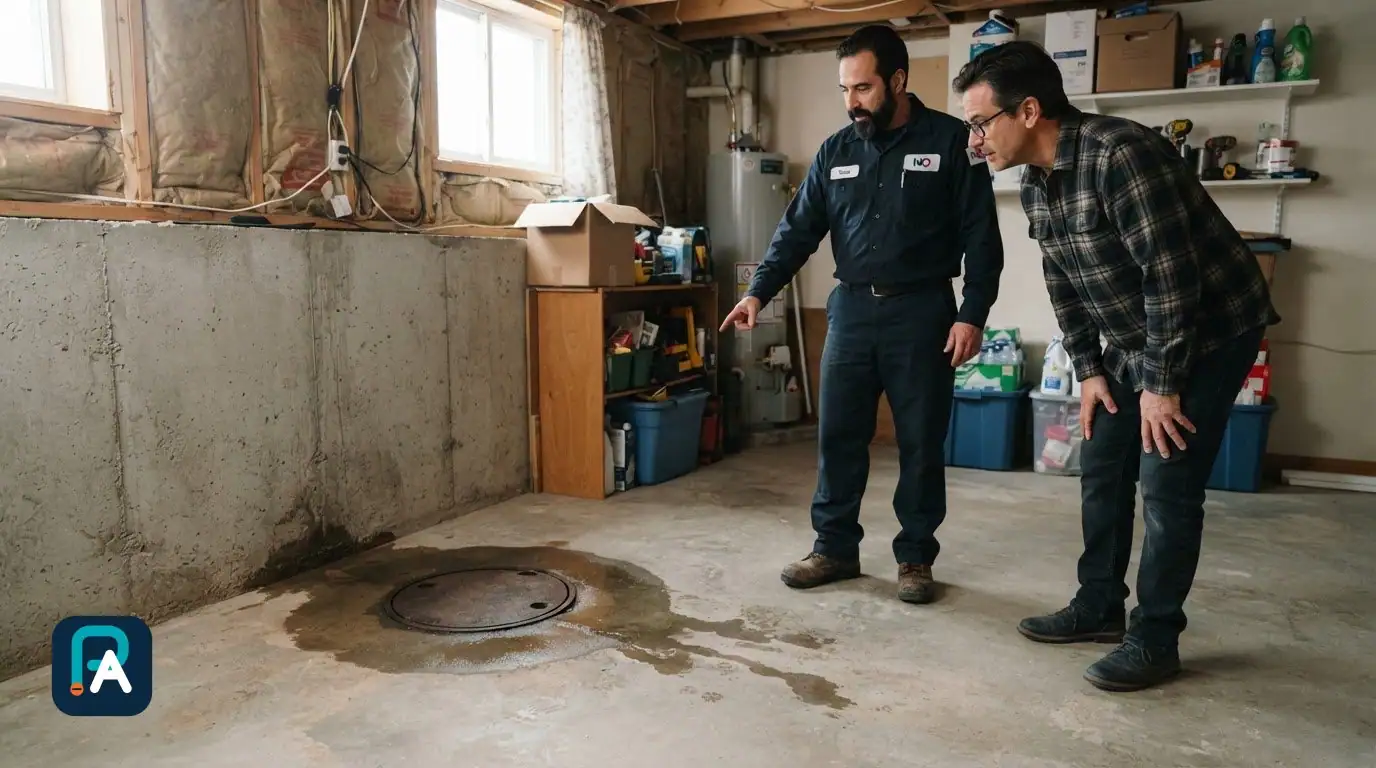
Without opening a sewer cleanout, you can check which parts are actually visible, what would obstruct its use and whether its closure has apparent exterior damage. You cannot confirm the condition inside the pipe. The first precaution is to establish what you are looking at: a floor cover may protect an access opening without being the plug that closes the pipe itself.
This observation helps you understand an existing installation and avoid concealing a maintenance point behind new finishes. It requires no unscrewing, drainage test or opening of the floor. If water is escaping or the area is contaminated, stop the preventive check and have the incident addressed separately.
Key takeaways
- A cleanout provides access to part of the drainage network for maintenance; its presence does not describe the sewer’s condition.
- A pipe plug, finishing cover plate and access panel in the building can be three different components.
- A visible opening may remain unusable if furniture, a partition or a finish prevents work around it.
- A cracked, distorted or visibly incomplete component needs assessment without trying to tighten or reposition it.
- The cover’s appearance cannot establish the pipe’s exact diameter, its route or how much of the network can be reached.
What is a closed cleanout for?
A cleanout is a point designed to give access to the inside of a pipe for certain maintenance operations. It preserves a way to reach the drainage network without creating a new opening each time work is needed. It normally remains closed between those interventions.
The CMMTQ’s PL-24 guidance on access to plumbing components, in French, explains that function: making part of the system accessible for unclogging, cleaning or maintenance. The cleanout is therefore part of the plumbing installation. It is more than a finishing detail that can simply disappear when a room is remodelled.
Its location depends on the section it serves. It may be visible on exposed piping or reached through an opening provided in the finishes. The CMMTQ’s technical article on cleanout locations, also in French, illustrates several arrangements, including cleanouts associated with stacks and building drains. It helps explain why one property may have several maintenance access points.
For a homeowner, this affects how the visible parts should be described. A plug near the bottom of a vertical pipe and an opening in the slab should not automatically be called the main sewer cleanout simply because they are easy to find. Their role depends on the network to which they belong.
Begin with a straightforward distinction: the location may be known while the function remains unconfirmed. You can know that an opening is in the basement storage room without knowing which pipe it serves. Keeping that uncertainty clear is more useful than basing a maintenance plan on an assumed identification.
This also avoids treating every cover as interchangeable. An access point is useful because of the component and pipe behind it, rather than because it happens to be round or close to the floor. Its visible position is a starting point for identification, not a complete description of the installation.
How do the plug, cover plate and access panel differ?
In an unfinished basement, the plug may be directly visible in its fitting. In a finished room, another component may conceal it. People often use “cover,” “panel” and “plug” loosely in conversation, although those words can refer to different parts.
The plug forms part of the pipe’s closure
The plug closes the cleanout opening in the drainage system. Its shape, material and construction depend on the product. Manufacturer Canplas lists several cleanout-plug models with different configurations. A raised or recessed head does not, by itself, establish a different role within the house.
The closure also has a function separate from the finish in front of it. For example, Oatey describes a cleanout assembly designed to prevent sewer gas from escaping. A decorative part placed over an assembly does not automatically replace that function.
A cover plate or access panel leads to something else
A cover plate may neatly conceal an opening in a finished surface. Oatey’s cover-plate documentation describes products that hide the access hole for a cleanout plug. This does not mean every visible floor disc uses that particular arrangement. It does establish why one component can sit in front of another.
A building access panel, meanwhile, allows a person to reach a space or component behind a finish. Its frame may be larger than the plumbing part concealed inside. The visible plate, its frame and any underlying plug do not necessarily share the same dimensions.
| Component | Function to distinguish |
|---|---|
| Cleanout plug | Closes the opening provided in the pipe |
| Finishing cover plate | Conceals or finishes an access opening, depending on the product |
| Building access panel | Allows a component behind finished surfaces to be reached |
This table helps clarify the terms a professional may use. It cannot identify a concealed installation from a photograph. If only a cover plate is visible, describe it that way until what lies behind it has been confirmed.
Can the access point actually be used?
Seeing a component does not mean someone can work on it. An opening can remain visible beneath a low shelf, behind fixed cabinetry or in a corner where a partition blocks the approach. The useful observation concerns reaching the maintenance point and having usable space around it.
The PL-24 guidance discusses access to plumbing components. The CMMTQ’s 2025 cleanout article also separates access to the plug from other installation characteristics. These references do not give a homeowner one clearance to apply to every basement. The actual configuration needs to be assessed.
Identify obstacles that would affect the work
Look at fixed elements around the location: a closet back, cabinet base, partition, step or equipment installed in front. The question is more than whether a hand could reach the part. The intended opening and maintenance work must remain possible for whoever will carry it out.
Consider two situations. In one, a few dry storage boxes temporarily occupy the approach. In the other, the cleanout sits behind the back panel of a built-in storage unit. These impose different constraints. Moving ordinary stored items is different from dismantling construction to reach the plumbing.
A removable shelf can also create uncertainty. The owner may know how to take it out, but the access still needs assessment based on the space available afterward. Calling something removable does not establish that the whole arrangement is suitable.
Limit the check to what can be seen without work on the installation. Do not pull out heavy equipment, cut a panel or dismantle cabinetry to continue. A note such as “access visible, but approach blocked by a fixed cabinet” already identifies a question that needs resolving.
The value of this observation is separating an ordinary storage obstruction from a constraint built into the room. The first may sometimes be addressed through better storage organization. The second calls for reviewing the layout with the appropriate professional.
Which exterior defects need assessment?
Where part of the assembly is visible, look at its general condition without applying force. An apparent crack, distorted edge, clearly incomplete part or damaged fitting should be assessed. Those observations do not automatically establish the repair that will be required.
First identify which component appears affected. A cracked finishing plate and a cracked pipe plug do not have the same function. If the plug is hidden, it would be inaccurate to report it as broken based solely on damage to the outer cover. Conversely, an immaculate finish does not establish that the closure behind it is intact.
Observe the condition without testing the mechanism
A badly damaged wrenching surface, distorted head or tool marks may raise a question about an earlier intervention. They do not prove that the plug is seized or correctly tightened. Do not use a wrench to find out whether it turns. That would move the check from observation to manipulation.
The same caution applies to corrosion or surface deposits. Exterior appearance does not measure the remaining thickness of a component or establish which treatment product would be appropriate. Describe what is visible without scraping, applying penetrating oil or trying to tighten the closure.
If moisture is present, report it without attributing its source to the plug. A wet area around an opening does not establish that the pipe is leaking there. If water is escaping, sewage is present or electrical safety is a concern, keep away. The preventive access check can wait until the incident has been addressed.
Do not push on a cover to test its stability or deliberately step on it to check its strength. Visible distortion calls for identification of the product and assessment of its condition. An observational check cannot certify that a component is suitable for a particular load.
These distinctions help make the report more precise. “The outer plate has a broken edge; the plug is not visible” communicates a different observation from “the sewer plug is broken.” The first preserves what is known without assigning damage to a concealed part.
What can a closed cleanout not reveal about the sewer?
The outside of a cleanout provides information about one access point. It does not turn that point into a view of the whole drainage network. Separate the visible component’s characteristics from the properties of the hidden pipe.
The finish does not describe the entire installation
A metal cover does not establish that all the piping is metal. The cleanout assemblies described by Oatey combine different body and cover materials. The appearance of the top may therefore tell you something about that component without identifying the buried pipe material.
The width of a cover plate does not provide the pipe’s exact diameter either. There may be a frame, an opening in the finish and a plumbing fitting of different sizes. Measuring only the visible disc establishes neither the pipe’s nominal diameter nor the replacement part needed for a repair.
The number of visible openings does not measure access to the entire network. Several cleanouts may serve different sections. One visible maintenance point does not mean every other section can be reached through it. The layout, changes of direction and connections need technical identification.
A normal appearance is not an internal check
A plug that looks dry from outside cannot establish that the pipe is clear, its joints are intact or its route has no defects. It also cannot locate a possible problem elsewhere. These questions go beyond looking at a closed access point.
The purpose is therefore not to select inspection equipment or a cleaning method immediately. It is simpler: establish what can be seen, recognize what remains concealed and avoid presenting an exterior impression as an assessment of the sewer.
How can access be preserved when the room is remodelled?
A maintenance point can become less usable after work that appears unrelated to plumbing. New flooring, custom storage or a wall finish may change the approach, conceal the closure or prevent the intended access panel from moving.
Before choosing finishes, have the components that must remain accessible identified. The plan needs to account for the part to be reached, the necessary opening and the room’s use. Leaving a small portion of the cover visible through a cutout does not settle those questions.
Distinguish a removable finish from planned access
A loose rug and glued-down carpet do not create the same obstacle. Movable furniture and a cabinet fixed to the floor are not removed under the same conditions either. These comparisons help frame a design question; they are not automatic approval of a particular solution.
Avoid assuming access is acceptable because a future worker “can always cut it out.” That statement postpones the problem until the next maintenance operation. The solution should be part of the room’s design rather than depend on improvised demolition.
Finishing the surrounding surface is also different from modifying the plumbing closure. Do not have an unidentified component glued, sealed or altered solely to make a floor or wall look uniform. An aesthetic choice should follow identification of its function.
If the basement is being transformed, this question can be included in a renovation plumbing assessment. The specific objective is to preserve useful access to the existing cleanout or have necessary changes evaluated before the new finishes make the issue harder to resolve.
Frequently asked questions
If no cleanout is visible, does that prove there is none?
No. A lack of visible access does not distinguish a concealed installation, a location not yet identified and a missing component. Start with available renovation records or have the plumbing identified. Do not remove tiles or open several walls at random. Locating an access point and evaluating whether the required component is present are separate steps to organize.
Can you buy a universal plug to replace one that looks worn?
Do not select a part by resemblance or by the size of the outer cover. A replacement must match the actual fitting and assembly, including its closure arrangement. The variations shown by manufacturers explain why identification matters. Have the part and its installation confirmed rather than removing the existing plug to take it to a store as a sample.
Should the cleanout be opened at fixed intervals to check the sewer?
The access point’s appearance cannot establish an opening schedule. Have suitable maintenance determined from the installation, its history and instructions for the components concerned. A known, accessible cleanout remains useful without the occupant periodically dismantling it. A technical opening needs an objective and appropriate precautions. It is different from an ordinary visual walk-through of the basement.
Can the cleanout be used as a drain connection for an appliance?
Do not use it as an improvised discharge point for a drain hose, pump or other appliance. A cleaning access and a drainage connection designed for equipment serve different needs. An added appliance should be assessed in relation to the network and applicable requirements, rather than connected by leaving a closure open or feeding a flexible hose into it.
Does a name on the cover identify the concealed network?
A brand or reference may help locate documentation for the visible component. It does not necessarily describe what lies underneath or how the house is connected. Identifying a product and establishing its role in the installation are separate matters. A readable marking is useful information to share, without becoming proof that the cover protects the main sewer cleanout.
A closed cleanout can therefore be checked usefully: identify what is visible, notice obstacles to maintenance and have exterior defects assessed. Keeping that scope clear helps preserve access without turning a preventive observation into an opening of the pipe.