
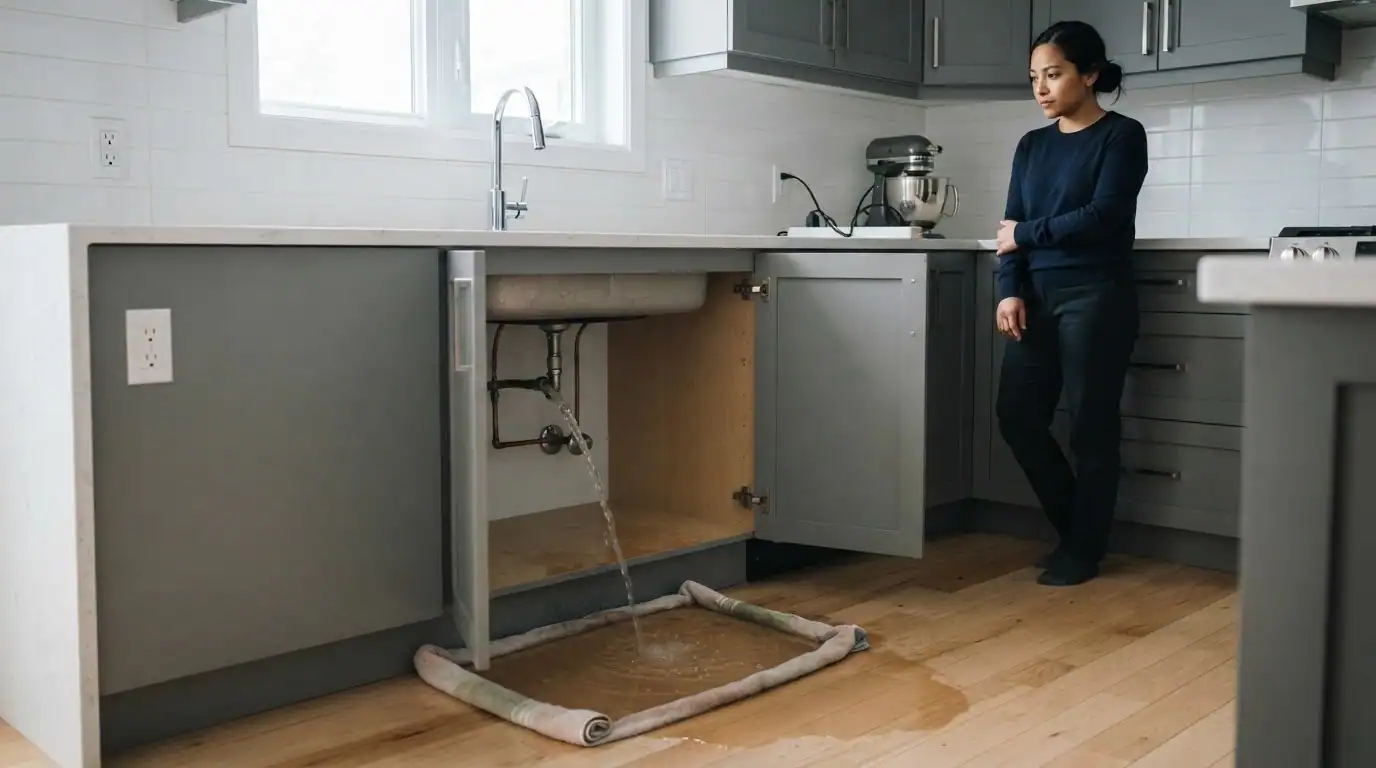
A water leak alarm can tell you when its sensor gets wet. A phone notification can reach you while you are away. A system connected to a shutoff valve may also stop the supply of water under the conditions it was designed for. Those are three different levels of protection. The right choice depends on where water could appear, how long the home is empty, and who can respond when an alert arrives.
The photograph of water pouring from plumbing below a kitchen sink illustrates why response time matters. It does not show a detector, and it cannot tell us whether an automatic shutoff would have limited that particular incident. A well planned system may reduce the consequences of some future leaks. It cannot make sound plumbing unnecessary or repair a failed connection.
Key takeaways
- An audible alarm helps only if someone hears it and can take action.
- A phone alert tells you about water; it does not close a valve unless the system has that separate function.
- Automatic shutoff may reduce a leak on the portion of the water supply the valve controls, provided detection and closure both work.
- A contact sensor responds to water that actually reaches its sensing surface or cable.
- Closing a drinking-water supply line does not necessarily stop rainwater infiltration or a sewer backup.
- Sensor placement, testing, power, connectivity, and a response plan matter as much as the device itself.
Table of contents
- What does a water leak sensor detect?
- Alarm, phone alert, or shutoff: what changes?
- Where should sensors go?
- When is automatic shutoff useful?
- What damage can the system miss?
- How do you keep the protection ready?
- Frequently asked questions
What does a water leak sensor detect?
A basic water alarm has contacts that react when water reaches them. Some models use a sensing cable to cover a longer path. The device does not see through a wall or inspect the condition of a pipe. It reports a condition at the point it can measure. The Government of Canada’s guide to water alarms makes an important distinction: the alarm can warn of unwanted water, but it cannot identify the underlying cause.
Consider a sensor on the floor of the cabinet under a sink. It can warn you if water collects there. It cannot tell you whether the water came from a supply connector, faucet, drain fitting, dishwasher, or another path. If water runs through an opening at the back of the cabinet and reaches the ceiling below before touching the sensor, the alarm may remain quiet. A sensor is a watch point, not a guarantee that every pipe in the room is being monitored.
Other products monitor the supply itself, using flow or other measurements to look for unusual water use. They answer a different question: is water moving through the line in a way the system considers abnormal? That approach may catch an event that never wets a floor sensor, but thresholds, learning behaviour, and exclusions differ by product. A long normal use and a small ongoing leak may be interpreted differently depending on the settings. Ask what the device measures, how it decides to alert, and what it cannot distinguish.
An alert does not always mean a pipe has burst. Cleaning water, condensation, an overflowing fixture, or water arriving from elsewhere can wet a sensor. Someone still has to establish what happened. This is a useful limitation to understand before buying: an early signal can prompt a timely check without claiming to be a plumbing diagnosis.
Alarm, phone alert, or shutoff: what changes?
A local audible alarm is most useful where someone is likely to hear it. If an occupant is home, recognizes the sound, and can safely reach the appropriate shutoff, the warning can shorten the response. In an empty home, an alarm in a closed basement room might sound for hours without changing the flow. Test whether it can be heard through closed doors and think about overnight as well as daytime conditions.
A remote notification adds a person outside the home to the chain. Depending on the model, it can arrive through an app or a monitored system. That can be valuable while you are at work or travelling, provided the device has the power and connection it needs and someone actually receives the message. Then comes the practical question: who has access to the building, knows which unit is affected, and can arrange a safe response? A notification delivered promptly to someone who cannot get inside may still leave water running.
Automatic shutoff links detection to a valve on a specified supply line. Some smart systems can close the home’s water supply automatically, and the Government of Canada says this more complex setup should be installed by a professional. CAA-Quebec’s guide to water leak detectors describes sensors near connected appliances and an electric valve that can close the supply when water is detected.
The word can matters. Confirm that the chosen sensors communicate with the chosen valve, that automatic action is enabled, which pipe the valve closes, and what happens during a power or network failure. Some packages provide an alarm and an app but no motorized valve. Others require a person to confirm the closure. The label “smart leak detector” does not establish the behaviour of a completed installation.
Where should sensors go?
Start with a map of water connections and the rooms below them. A kitchen sink, dishwasher, washing machine, water heater, toilet, and refrigerator water line expose different areas. Canada’s guidance suggests locations including washing machines, hot-water tanks, toilets, and under sinks. It also suggests multiple alarms where fixtures are spread across a large home or several floors. These examples are a starting point, not a promise that every leak will run toward the proposed sensor.
Under a sink, look at the bottom of the cabinet. Is it level? Are there openings around the pipes? Could water run along the back wall or out onto the kitchen floor before collecting at the front? Put the sensor where water is reasonably likely to reach its sensing surface, following the manufacturer’s instructions. Keep it accessible for testing and battery changes. A sensor buried behind stored bottles can be difficult to inspect and may be moved without anyone noticing.
A sensing cable can extend the area being watched when the product supports one. It still has to follow a plausible water path and the manufacturer’s placement rules. One cable under the sink does not protect the dishwasher simply because both are in the kitchen. Likewise, a leak from a dishwasher’s rear connection may travel differently from water escaping below its door. If the paths are separate, plan separate coverage rather than counting rooms.
At a water heater, a drain pan, floor drain, and floor slope can change where water gathers. Keep the device clear of the access needed to inspect or service the equipment. Around a washing machine, consider the supply connections, drain hose, and the space beneath the appliance; a single spot sensor cannot necessarily cover all three. Revisit the plan if an appliance is replaced or moved, since the water path may change.
In a condo or multi-unit building, water can reach another unit through a floor opening before a large puddle forms in yours. That makes a timely alert valuable, but it also shows why an alarm in one cabinet cannot guarantee protection for neighbouring spaces or shared pipes. For each sensor, write down what it watches, where water should reach it, and who receives its alert. If you cannot explain those three things, reconsider the location before relying on it.
When is automatic shutoff useful?
A shutoff system has particular value when a supply leak might continue while nobody is there to respond. That may be a house empty most weekdays, a condo left vacant during travel, or a unit above another finished space. If a trusted person can respond quickly to a remote alert, notification may be sufficient for the chosen level of risk. If nobody can reach the water valve soon, automatic closure can reduce the additional water released after a qualifying leak is detected. It cannot recover water already on the floor.
The valve’s location defines its reach. A valve on a unit’s main supply may close several downstream fixtures. A valve on one branch covers that branch. Water escaping from a section upstream of the valve may continue even after it closes. In an apartment building, a shared supply can serve several units, so a closure may affect neighbours. A professional should confirm the actual piping layout and the consequences of any proposed location. Do not infer the coverage from a photograph of a valve or from a product description.
Think through false or unexpected activations as well. What if routine cleaning wets a sensor? Who can reopen the valve, and only after what check? Is there an accessible manual control? What continues to work if electricity or Wi-Fi fails? CAA-Quebec notes that some systems have backup power. That is a feature to verify for the specific equipment being considered, not a property of every automatic valve.
For a renter, a stand-alone alarm may be easier to use than modifying the plumbing, subject to the building and product. A condo owner should check the syndicate’s rules and the boundary between private and shared piping before planning a motorized valve. A homeowner can weigh the location of the main shutoff, long absences, and any equipment that needs a continuous water supply. The full decision includes installation, ongoing maintenance, and how the system behaves offline—not just the purchase price.
What damage can the system miss?
Closing a drinking-water supply line does not, by itself, stop a sewer backup, rainwater entering a building, or water from an upstairs neighbour. A floor sensor might notice some of that water if it reaches the device. The valve controlling your supply does not remove the outside source. CAA-Quebec discusses leak detection separately from protection against infiltration and sewer backup in its guide to preventing water damage at home. Choose equipment for the route the water could take, rather than assuming all wet floors call for the same device.
Even within a supply system, water may stay inside a wall or move to another room without reaching a contact sensor. A dead battery, disconnected hub, moved probe, or failed valve may interrupt the intended response. Canada advises continued inspection for leaks even when alarms are installed. Look at accessible plumbing and appliances for unusual moisture, drips, deposits around a fitting, or a visibly damaged connector; arrange an assessment rather than assuming the alarm will catch deterioration before water appears.
A triggered alarm is also not a diagnosis. It tells you where a sensor reacted, while water may have travelled from a different location. Do not repeatedly restore the supply to see whether the alarm returns or dismantle a pressurized connection to test a theory. For an existing, active leak, the water leak repair page covers immediate precautions and how the source is assessed. This article addresses the protection decision before such a repair is needed.
Finally, a detector does not guarantee that damage will be covered by insurance. Québec’s Autorité des marchés financiers advises consumers to review the water-damage coverage and conditions in their own policy. If an insurer or seller mentions a premium reduction for a particular system, ask whether that system qualifies under your contract and what proof is required. Do not build the financial case for a device around an assumed discount.
How do you keep the protection ready?
Before installation, decide who receives an alert and what that person can actually do. A message on a silenced phone is not a response plan for an empty property. If a family member, neighbour, or manager shares responsibility, check that the right people receive alerts and have current contact details. Someone authorized to enter should know which unit is involved and how to get the appropriate help without operating an unfamiliar valve in an unsafe area.
After installation, test the chain according to the product instructions: water reaching the sensor, the local alarm, notification delivery, and, when properly coordinated, operation of the intended shutoff. Make sure the name shown in the app matches the sensor’s real location. In a building where a shutoff could interrupt other occupants, coordinate testing with the person responsible for the water system. The Government of Canada recommends testing alarms annually and changing batteries annually or as the manufacturer directs. Keep the actual model’s manual for its method and schedule.
Review the setup after a new phone, router, occupant, appliance, or renovation. A sensor moved during cleaning may no longer sit on the expected water path. A replacement dishwasher may change where a leak would appear. Alerts sent to a former manager’s phone are not useful to current occupants. A short record of sensor locations, power sources, notification recipients, and the pipe each valve controls makes these changes easier to catch.
If an alarm activates, first confirm whether water is present without entering an area affected by electrical hazards. An active leak must be understood and corrected; clearing a notification does not resolve it. After the problem has been addressed, dry and reset the device as its instructions require, then verify that it is again monitoring its intended location. A system left disabled after a false alarm provides no continuing protection.
Frequently asked questions
Is one detector under the sink enough for the whole kitchen?
No. It watches the area where water can reach that sensor. A leak behind the dishwasher or near a refrigerator water line may follow another path. Map the distinct connections and likely water routes before deciding how many sensors to use.
Can an alarm tell me which plumbing part failed?
It can identify the sensor that reacted, but water may have travelled before reaching it. It cannot establish whether a pipe, flexible connector, fixture, or drain is responsible. Check the situation safely and have a continuing leak assessed without taking apart a pressurized connection.
Does my phone have to be online for the valve to close?
That depends on the system. Local automation, app notifications, and manual remote commands may behave differently when the phone, Wi-Fi, power, or a hub is unavailable. Ask for the precise offline behaviour of the proposed model and confirm it at commissioning.
Will an automatic valve stop a sewer backup?
A valve on the drinking-water supply closes the line it controls. It does not, by that action alone, prevent wastewater from rising through a drain. A sensor could warn of water at its location, but the backup itself calls for measures directed at the drainage system.
Can I add automatic shutoff to a condo unit?
That depends on where the unit’s own supply can be isolated, whether piping is shared, and the building’s rules. Consult the syndicate and have the proposed valve’s actual reach checked before modifying the plumbing. A separate alarm may be possible even where an individual motorized valve is impractical.
Do detectors replace regular checks of fixtures and connections?
No. They respond to a condition they can measure; they do not certify that a connector, valve, or water heater is sound. Continue to check accessible areas and address signs of leakage. Good prevention combines maintained plumbing, sensible detection, and a person able to respond.
The useful question is “What will happen in this building when water reaches this sensor?” If someone will hear the alarm and act, a local device may be worthwhile. If the home is often empty, consider remote notification and, where the piping permits it, automatic shutoff on the right supply line. Verify the installation, test the complete response, and keep a plan for dealing with the leak itself.