
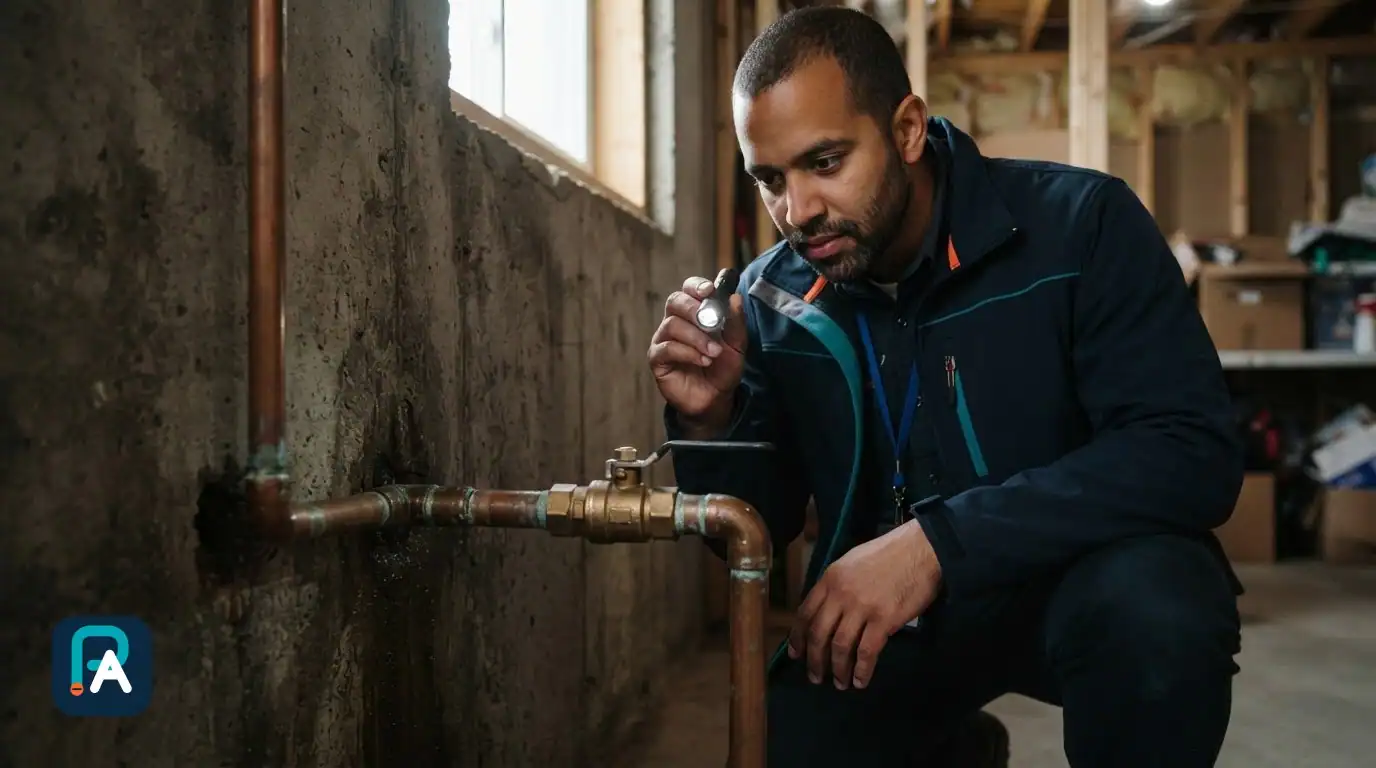
The main water shutoff valve lets you stop the water supply to a house, or to the portion of a building that the valve actually serves. To find it, look for the point where the water service pipe enters the building and follow the visible pipe to the first accessible valves. If several controls look alike, have the correct one identified before you need it during a leak.
Finding a valve is only the beginning. You also need to know what it shuts off and whether it still works. A handle may turn without stopping the water completely; a valve that resists should never be forced. This guide explains how to identify the indoor shutoff, prepare for a careful check, and recognize when a plumber should take over.
Key takeaways
- The indoor main shutoff is different from a small valve at a fixture and from the exterior water service valve.
- Follow the incoming water pipe rather than relying on the colour or shape of a handle.
- In a multi-unit building, a control may affect neighbours; establish its scope before any planned test.
- A seized handle, seepage, or water that continues to flow after closure calls for a professional assessment.
- Keep a clear record of the location, its known scope, and the person responsible for access to any shared or exterior shutoff.
Table of contents
- What does the main shutoff actually control?
- How can you find the right valve without opening the plumbing?
- What should you check before a planned shutoff test?
- What can the result of a careful test tell you?
- What if the valve is inaccessible or defective?
- How should you share the information with other occupants?
- Frequently asked questions
What does the main shutoff actually control?
In a home supplied by a municipal water system, a service pipe brings water into the building. The supply then branches toward taps, toilets, appliances, and other fixtures. The indoor main shutoff is intended to isolate the part of that distribution system it serves. A small stop valve beside a toilet or below a sink generally affects that fixture or a limited branch. The exterior water service valve, sometimes called a service box or curb stop, is a separate control with a different access procedure.
This distinction matters when you decide what to do. If a supply connector beneath one sink leaks, an accessible local stop may isolate that fixture. If the leak is upstream of that stop, several fixtures are affected, or the path of the water is uncertain, the main indoor valve may be the relevant control. Yet closing it will not resolve a sewer backup or rainwater entering the building. It may not isolate a leak in the service pipe before the indoor valve either.
Do not assume one visible handle controls an entire property. A converted house, duplex, condominium, or commercial space can have several branches and shutoffs. A valve near a meter or inside a utility closet might serve one unit, a shared line, or a specific piece of equipment. Its appearance cannot establish its scope without reliable records or a functional check. The CMMTQ’s technical note on shutoff valves (in French) explains that work on a domestic water distribution system first requires a way to interrupt water to the relevant fixture or network.
The main shutoff is therefore both a safety reference and a boundary within the piping system. Knowing its location does not mean you can safely repair a pipe. For a homeowner or occupant, the practical goal is to identify the right isolation point, understand who may use it, and report anything unusual before an emergency makes those questions urgent.
How can you find the right valve without opening the plumbing?
Begin where the incoming water pipe enters the building. In a house with a basement, that point is often near a foundation wall, in a utility room, or beside a storage area. Other buildings may place it inside a service cupboard or a shared mechanical space. These are places to look, not promises about every property. Renovations may have enclosed the pipe, moved accessible fittings, or changed the route visible to an occupant.
Make the first search visual. Look for the pipe arriving from outside, follow the exposed section, and note the controls before the supply branches toward fixtures. A meter, filter, treatment device, pressure regulator, or several neighbouring pipes can make the route difficult to read. The first handle you see may not be the shutoff for the whole building. Equipment can have a valve on each side, while another valve controls only a branch.
Use a flashlight if the area is dim. Take one wide photograph that shows the room and pipe route, then a closer photograph of the suspected valve and any existing label. Keep clear of outlets, electrical panels, wiring, and wet areas. Hydro-Québec’s guidance on water damage explains the hazard when water and electricity meet. If reaching the valve would mean walking through water near electrical equipment, do not enter the area to continue your search.
There is no reason to remove a fixed panel, cut a finished wall, or move a pipe just to confirm a guess. Sometimes the most useful information to give a plumber is precisely what you do not know: “The water pipe appears to enter through this wall, and there are two possible valves, but I cannot tell which one shuts off the house.” A photograph of the surrounding pipework is usually more useful than a close-up showing only a handle.
If there is no basement or the supply is hidden, consult building plans, maintenance records, the previous owner’s notes, or the person responsible for the property. In a condominium, the syndicate or manager can help distinguish private and common controls. In a rental, the landlord or building manager can explain the authorized procedure. Do not label an uncertain valve “MAIN” based on a visual guess. An incorrect label could send someone to the wrong control during a leak.
What should you check before a planned shutoff test?
A useful test is planned for a calm time, when no one depends on the affected water supply and the system can be observed after it is restored. A spreading leak late at night is a poor time to learn how an old valve behaves. Before touching it, confirm that access is safe, the pipe and handle show no visible leak, and you know whom to contact if normal service does not return.
Look at the handle and nearby fittings without taking them apart. Heavy corrosion, a damp deposit, a fresh water mark, seepage around the stem, or an unstable support are reasons to postpone the test and request an assessment. A handle that moves a little does not prove its internal closure moves with it. Unusual resistance should not be overcome with pliers, a wrench, or an added lever. The Société d’habitation du Québec maintenance sequence (in French) specifically advises against forcing a seized main valve and calls for a specialist when needed.
Find out who else would lose water. A single-family home’s supply may be straightforward to coordinate; a duplex, apartment building, or commercial property is different. An unannounced test could interrupt another household, a business activity, or equipment that needs water. Ask the manager or condominium syndicate which control an occupant may operate, when, and under whose supervision. If no one knows what it serves, identification comes before testing.
Distinguish a visual check from a functional one. An occupant can learn where an accessible valve is and keep the route to it clear. A full shutoff, especially on an old or shared valve, should be coordinated with a knowledgeable person whenever the valve’s condition or the piping layout is uncertain. The same caution applies if a leak detection system is connected. The separate guide to water leak detectors covers sensor and automatic-shutoff testing, but it does not establish the identity or condition of a manual indoor valve.
Planning also gives you time to decide what an inconclusive result will mean. Which fixtures should stop receiving water? Which ones belong to another unit? Will someone be present to check the valve itself for fresh seepage after reopening? Without those answers, turning a handle produces an event but little reliable knowledge. The purpose of an arranged test is to confirm the scope and performance of the control, not simply to prove that its handle can move.
What can the result of a careful test tell you?
When a planned closure has been judged appropriate, observe what happens at fixtures believed to be downstream. The handle position alone is not the result. A flow that diminishes and stops after water already in the pipes has drained is consistent with isolation of that section. A steady trickle, unexpected return of pressure, or fixtures that remain supplied may point to incomplete closure, another supply path, or the wrong valve. Checking one tap for a few seconds does not necessarily tell you what happens throughout a complex building.
The type of handle offers a clue about normal movement, but it should not be treated as a universal instruction. A lever-operated ball valve generally travels about a quarter turn; a wheel-style valve generally requires several turns. Their apparent positions may show what the mechanism is meant to do. They cannot prove the internal seal is sound or identify every branch it controls. Do not continue turning beyond a stop or guess how to operate a damaged control.
After a planned reopening, look again at the valve and visible connections. A new drop at the stem, body, or joint needs attention even when water has returned to the fixtures. One successful closure also does not guarantee that the valve will behave the same way months later. The Québec housing agency’s maintenance sequence treats handle operation, leakage at the valve, and continued water delivery to fixtures as separate observations. It directs the maintainer to seek specialist repair when the control does not perform as expected.
Record the outcome precisely: date, person present, valve identified, scope confirmed or still uncertain, normal movement or resistance, water stopped or still flowing, and any seepage before or after. Avoid writing “everything works” when only one fixture was observed. “The kitchen tap stopped, but the garage line was not checked” is a more useful note. It gives a plumber a starting point without pretending that a partial check diagnosed the whole system.
If you discover an active leak during a test, stop experimenting and have the situation assessed. The water leak repair page addresses finding and correcting the source. This guide is about knowing whether the water can be isolated. It is not a procedure for opening a pressurized fitting or replacing the valve yourself.
What if the valve is inaccessible or defective?
A control buried behind boxes, enclosed by a finish, or inside a locked room will be hard to use at the critical moment. Clear the route where you can do so without disturbing pipes or electrical equipment, and arrange access to locked spaces with the responsible person. If reaching a valve requires an awkward climb or opening a concealed space, have a lasting access solution assessed instead of relying on an improvised ladder during a leak.
A seized, corroded, or dripping valve deserves attention before an emergency. Note whether the problem seems to involve the handle, stem, neighbouring connection, or continued water flow after an attempted planned closure. Those clues do not all indicate the same defect. A professional needs to establish which section must be isolated for the work, assess the fittings, and plan how water will be restored. Replacing an indoor valve is a different project from replacing a buried service pipe; the water service line page explains that distinction.
If the indoor shutoff cannot be used and work requires the exterior service valve, do not try to operate a service box at the street or on the property yourself. In Montréal, the city directs owners to their borough for exterior valve location, shutoff, and reopening. The procedure and timing depend on the borough and circumstances. Elsewhere, check the relevant municipality’s process. A plumber can establish what needs isolation, while the municipal exterior shutoff follows its own procedure.
There is a difference between a preventive discovery and damage already in progress. If a valve merely feels resistant during a planned check, stop and arrange an inspection. If water is spreading and the indoor supply cannot be shut off safely, warn anyone affected and contact the appropriate service for the leak and exterior shutoff. Montréal’s guidance specifically includes an indoor main valve that cannot close during damaging water flow among urgent situations. Do not wait for a perfect diagnosis before reporting active water loss.
An inaccessible valve is also a communication problem. A professional may be able to inspect it during an ordinary visit, but that does not help an occupant who does not know whom to call or who holds the key. Ask the building’s responsible person to document the access route and escalation process along with any repair that is needed. If a shared closure affects other units, make sure the plan includes notice and coordination rather than leaving that decision to the first person who encounters a leak.
How should you share the information with other occupants?
A shutoff known to only one person may be difficult to find when that person is away. Make a brief, dependable record: a wide photo of the room, a closer photo of the confirmed control, directions to reach it, what it serves, and the name or role of the person who confirmed that scope. A readable label beside an identified valve may help, but do not cover a meter number, existing instruction, or equipment marking. Update the record if a renovation changes the pipe layout.
In a house, show other adults the actual route, including how to enter the utility room if it is locked. “In the basement” is too vague when several pipes and handles look similar. A short note kept with the home’s emergency contacts is easier to use than an unexplained photo in someone’s phone. Record useful fixture shutoffs separately; a leak confined to one appliance does not always require stopping water throughout the house.
In a rental or condominium, respect who controls shared equipment. A common valve may also serve neighbours, so an occupant should not assume it is theirs to close for an ordinary test. The practical plan needs the manager’s, landlord’s, syndicate’s, or on-call contact information and a way to report a leak outside normal hours. Ask for the scope of the valves to be confirmed and recorded during maintenance rather than relying on what a previous occupant remembers.
Consider what happens while the home is empty. Someone receiving a remote leak alert needs authorized access and reliable directions to the correct control. If the route depends on a locked door, caretaker, or another owner, record the communication chain without posting access codes on a public label. The aim is to help the right person make a safe decision promptly, not to encourage several people to try an unidentified valve.
Keep the instructions short enough to use under stress. An entry might identify the room, describe the confirmed valve, state whether it serves one unit or a shared line, and give the responsible contact. Put uncertain details in a separate note marked as unconfirmed. A neat diagram is helpful only if it matches the actual piping; an outdated diagram can be worse than a clear admission that the route needs to be checked.
Frequently asked questions
Is the main shutoff always beside the water meter?
No. A meter may be a useful clue, but its position and the arrangement of nearby valves vary. There can be one control before an item of equipment and another after it. Follow the visible supply route and have someone confirm which valve isolates the section you need. Do not identify the first handle you see solely by its proximity to the meter.
Can I identify it by a red or yellow handle?
Colour is not a reliable test. Handles can be changed, painted, or used on different equipment. You need to understand the pipe route and the actual scope of the shutoff. Where other systems are present, do not turn an uncertain control simply to see what happens.
Why is there still water at a tap after shutoff?
Water may remain in a section of pipe after the supply has been closed. A brief flow that weakens differs from a steady supply that continues. Fixture height, the piping layout, and possible alternate paths complicate the result. Report a persistent flow or uncertainty about the valve’s scope instead of diagnosing the entire building from one tap.
Does a moving handle guarantee a watertight closure?
No. Handle movement and effective shutoff are separate observations. An internal part may be worn, or the valve may serve only one branch. During a coordinated test, observe the fixtures thought to be downstream and check for new leakage around the valve body or stem. A problem calls for assessment, not disassembly by an occupant.
Should I close the main water supply before a short trip?
It depends on the piping, equipment that still requires water, other occupants, and building rules. A poorly understood shutoff might interrupt an appliance or a neighbouring unit. Agree on a plan with the manager or a professional if you do not know what the valve controls. The separate leak-detector guide covers alerts and automatic shutoff as another consideration.
What if the only valve I can find is in a locked common room?
Ask the building manager to identify it, explain whom it serves, and document the emergency access procedure. Keep the correct contact information. Do not bypass a lock or operate a shared control without coordination. This is best settled before a leak, when the people responsible can confirm the details.
Good preparation means being able to point to the right control, explain what it isolates, and recognize when to stop. Locate it now, keep safe access clear, record what remains uncertain, and have resistance, seepage, or incomplete closure checked. If water is already spreading, occupant safety and appropriate isolation take priority over an improvised test.
SEO overlap — October 4, 2026
I checked the English tips hub and all five category archives, including the live leak-detector article, against the closest water service line and leak repair pages. This article’s question is how an occupant identifies the manual indoor shutoff, confirms its scope, and recognizes an unreliable valve. The other pages cover automatic detection, service-line work, and active leak repair. Plomberie Anjou