
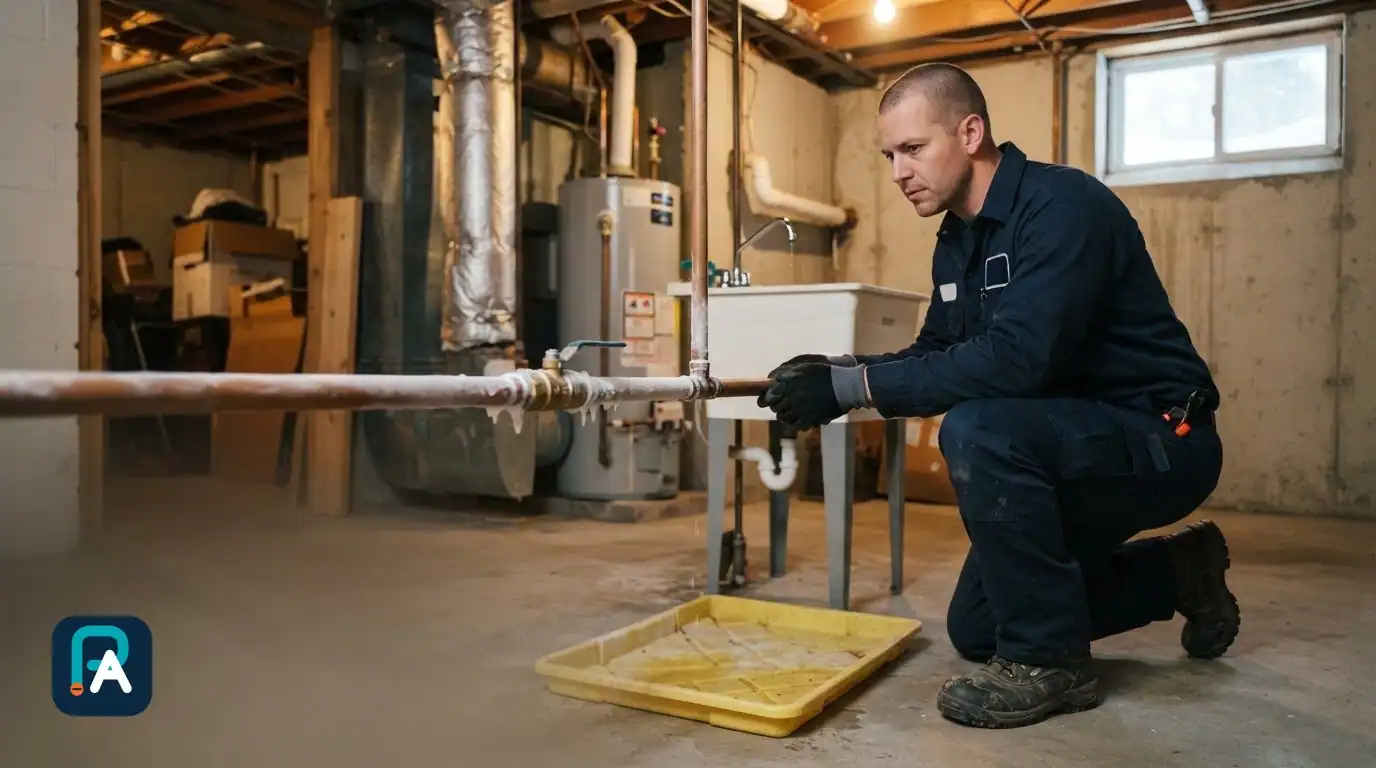
The thermostat says the house is warm, yet a pipe in the basement has frozen. Often the explanation is a very local cold spot. Warm room air may not reach the pipe, an opening near the foundation may admit outdoor air, or the pipe may run behind a finished wall on the cold side of the insulation. A temperature reading in the living room cannot describe every corner of the building.
Once the affected pipe has been made safe and checked, the useful question is: why did this particular location get so cold? This guide helps you prepare that investigation and understand the kinds of corrections that may be considered. It does not replace a frozen-pipe assessment or instructions for an active leak. For an immediate problem, see the frozen and burst pipes service page.
Key takeaways
- A heated room can contain a wall cavity, foundation corner or water service entry that is much colder than the air measured at the thermostat.
- The pipe’s route matters as much as its material. A short run behind a wall or close to an exterior penetration may be its weak point.
- Foam pipe insulation slows heat transfer. It does not produce heat or stop a cold draft from entering the building.
- Photographs, the timing of the problem and the heating history can guide an assessment without opening a wall at random.
- The eventual correction may involve plumbing, air sealing, insulation or heat distribution. The actual cause should guide the choice.
Table of contents
- How can the basement feel warm while the pipe freezes?
- What can the pipe’s route tell you?
- Where could cold air reach the plumbing?
- Why might insulating the pipe alone leave the problem unresolved?
- What evidence can you collect before a professional assessment?
- How can you choose a correction that addresses the cause?
- How should you follow up before the next severe cold spell?
- Frequently asked questions
How can the basement feel warm while the pipe freezes?
We normally measure air temperature where a thermometer is easy to place. A water pipe may occupy a different environment: against concrete, behind a closed cabinet, inside a poorly ventilated cavity or close to a joint exposed to wind. Two spots a few metres apart need not have the same temperature. The CMMTQ explains in its French-language guidance that an ice blockage may develop even while the indoor temperature remains above freezing, depending on weather and the building’s insulation.
Imagine a basement whose open central area receives plenty of heat. A supply pipe rises beside the foundation, then enters an enclosed chase. The thermostat describes the occupied area; it does not measure the air behind that chase or the surface beside the pipe. This is an example of a possible layout, not a diagnosis of a particular home. A partial heating failure, an open garage door or another route for outdoor air could create a similar situation.
Exposure and time both matter. A little warm air movement may be enough during ordinary weather but insufficient through a long cold spell. Wind can make an air leak worse at some times than others. For that reason, saying that the heating system is working does not settle the issue. You need to know whether heat actually reaches the pipe and where cold air might enter its immediate surroundings.
There is also a difference between the visible basement and the space next to it. An attached garage, a crawl space and the area behind a finished partition are not automatically part of the same heated volume. A branch line that passes briefly through one of those spaces may lose the protection you assumed it had from looking at the open room. Understanding that route is more useful than immediately adding another portable heater.
What can the pipe’s route tell you?
Before choosing insulation, establish which line and which part of the building are involved. A water service pipe crossing the foundation, a branch to a bathroom sink and a seasonal line serving an outdoor tap have different paths. The fixture with no water is not necessarily beside the coldest section. Even visible frost on one piece of pipe does not show the location of every ice blockage along a concealed route.
You can make a simple sketch using what is already visible: the water service entry, rooms supplied, exposed runs, exterior wall, basement window, garage door and enclosed spaces. There is no need to remove a finish, disconnect a fitting or pull on a pipe. If the line disappears into a wall, mark that portion as unknown rather than drawing an imagined continuation. An old plumbing plan may help, but subsequent renovations could have changed the route.
This approach prevents a misleading conclusion. A pipe in the middle of the basement may feel cool without being responsible for a loss of water. Conversely, a short length behind a cabinet or where the floor framing meets the foundation may be exposed to cold while most of the supply network remains warm. In a multi-unit building, clarify shared pipe routes and shutoffs with the person responsible for the property. An improvised shutoff could affect neighbours.
For the service entry, the Ville de Montréal advises keeping access clear and maintaining an air temperature of at least 10°C around the service line. This is a local preventive recommendation for that area. It does not prove that every branch in a building is protected because a thermometer elsewhere reads 10°C. A reading beside the relevant entry and an interpretation of the pipe’s full route answer different questions.
The separate main water shutoff valve guide explains how to identify a valve and determine what it controls. The purpose here is to relate a vulnerable pipe to the part of the building it crosses, without repeating that valve check.
Where could cold air reach the plumbing?
The top of the foundation wall deserves attention. Small gaps where concrete meets the wood framing can let cold air enter close to a pipe. The Gouvernement du Québec’s air-sealing guidance describes this joint and explains that the area should be sealed before the top of the wall and rim joist are insulated. A comfortable basement can therefore still have a cold strip around its perimeter.
Penetrations through the building envelope form another group of possible pathways: the water service entry, cables, dryer vent, ventilation ducts and window frames. The same provincial guidance lists these among locations where air may move if sealing is incomplete. Proximity to an opening is a clue to investigate, not permission to fill every gap with spray foam. Materials, moisture control and required clearances vary with the type of penetration.
Consider the pipe’s position relative to the heated interior as well. It could run on the exterior side of a wall’s insulation, sit in a closed cabinet with little warm-air circulation or pass through a ceiling over a garage. Raising the thermostat might warm the occupied room without sufficiently changing the pipe’s surroundings. First confirm the pipe’s location and which side of the building envelope it occupies.
Moisture makes the evidence harder to interpret. Water on a cold pipe might come from a leak or condensation, among other possibilities; it does not by itself prove a cold-air infiltration. If you see pooling water, a crack, distortion or water near electrical components, stop close observation and have the situation made safe. The investigation into cold exposure can resume after the immediate hazard has been addressed.
Why might insulating the pipe alone leave the problem unresolved?
A sleeve around a pipe slows heat exchange with its surroundings. It does not heat the water. If the pipe remains for a long time in a cavity swept by freezing air, a sleeve alone may not be enough. Montréal recommends both insulating vulnerable pipes and sealing drafts near doors, windows and service penetrations. These measures address different mechanisms: heat loss around the pipe and a continuing supply of cold air to the space.
Insulating the pipe is also different from insulating the foundation wall. Adding material to a partition without knowing where the pipe lies could leave it on the colder side of the new assembly. The Gouvernement du Québec’s insulation guidance emphasizes continuity at joints and a choice of materials appropriate to the location. It also warns that adding insulation to the inside of a foundation can increase certain ground-freezing risks in specific conditions. A picture of the pipe alone is therefore inadequate for designing a foundation retrofit.
The order of work matters. If water is entering through the foundation, enclosing damp materials behind a new finish can create a separate problem. If a pipe is in an area that cannot receive heat from the room, replacing its sleeve without examining the route or the envelope leaves the cold exposure intact. An assessment may lead to better air sealing, changes to insulation, restored warm-air circulation or a different plumbing route. The right combination depends on the building.
Heat-tracing cables are not an automatic answer either. A proposed system has to suit the pipe and its surroundings, follow the product instructions and have a reliable electrical supply. It does not replace an investigation of a draft or an examination of a pipe that may already be damaged. If an electrical solution seems appropriate, get advice for the actual installation rather than improvising around water or in a damp space.
What evidence can you collect before a professional assessment?
A careful description helps more than an early claim about the cause. Record the date of the incident, the cold-weather conditions, the affected room and any change in heating or building use. An open door, a power outage, recent renovation work or a newly closed utility cabinet might matter. It is useful to say when none of those events occurred, too. No one observation proves where the water froze.
If the area is dry and safely accessible, take wide photographs showing the pipe in context: the wall, window, framing, penetration and any visible heat source. A tight close-up of frost gives little information about the route. A second image from farther back can show the foundation joint or an enclosed chase. Do not touch electrical equipment, move an appliance or open a finished wall to obtain a picture.
A temperature reading can help when its location and conditions are recorded. Note exactly where the thermometer was placed, when you read it and whether a door was open. The result cannot describe an inaccessible cavity, and a reading taken after warming the room cannot recreate the temperature when freezing occurred. Avoid treating a single number as proof of the cause.
Ask when the plumbing or basement was last changed. A new finish could have restricted warm air from reaching an old pipe; a rerouted branch could now be closer to an exterior wall. A previous incident at the same location points toward a recurring vulnerability, although a different failure might have happened this time. In a shared building, collect observations from other occupants while keeping reported facts separate from guesses.
For a wider investigation of building air leaks, the Gouvernement du Québec describes a blower-door test as a more reliable detection method than simple visual clues. The test informs an assessment of the envelope. It does not replace a plumber’s examination of the pipe and fittings. Those evaluations answer complementary questions.
How can you choose a correction that addresses the cause?
Start by separating the damage to repair from the exposure to correct. A split pipe is a plumbing problem that needs assessment. Even after a repair, the cold conditions that affected it might remain. Conversely, sealing an air leak does not establish that a pipe or fitting that froze is undamaged. One job is not automatically a substitute for the other.
If the assessment identifies air entering where the framing meets the foundation, the project concerns the building envelope. If a partition or cabinet keeps warm air from reaching a pipe within the heated volume, the project may involve the room layout and air circulation. If the pipe truly runs through a cold garage or crawl space, the question is broader: should that space be protected, the pipe route reconsidered, or another measure chosen for the way the space is used? These are decision paths, not instructions to start work without examining the property.
Insulation calls for an overall review. The continuity of the air barrier, foundation moisture, the position of the pipe relative to the insulation and existing finishes all affect the choice. A building-envelope specialist can examine heat loss and air leakage; a plumber can assess the water line, fittings and routing. Coordinating their findings during a renovation reduces the chance that a new wall will conceal the same vulnerable spot.
Before accepting a proposed fix, ask what observation supports it and what it leaves unresolved. Does it close an identified route for cold air? Will valves and fittings remain accessible? Does protection depend on uninterrupted power or heating? Can the result be checked without reopening the new finish? These questions help compare proposals without turning this guide into a construction specification or quotation.
General winter preparation still matters, but it does not replace a correction to a known local weakness. Montréal provides frozen-pipe prevention advice. Follow the instructions from your own municipality when a measure affects the water service or water flow. The basement assessment, meanwhile, should remain grounded in this building’s pipe route and conditions.
How should you follow up before the next severe cold spell?
A repair completed in mild weather does not yet show how the area will perform during the next cold spell. Ask which parts were checked, which gaps were sealed or insulated, and which sections remain difficult to access. Keep a simple record with photographs after the work and the location of components that need to remain reachable. This is a maintenance reference, not a performance guarantee.
When cold weather first returns, compare conditions around the formerly affected location with the rest of the basement without handling the pipe. If that area becomes much colder again, moisture appears or a fixture behaves differently, report it early. You need not wait for a second complete freeze before asking for an inadequate correction to be reviewed. A new assessment can also make sense after changes to heating, finishes or the foundation area.
In a shared building, tell the manager where vulnerable sections are, which access points must stay clear and what has changed. One occupant cannot always see the same part of the network as another. Consistent information helps distinguish a local issue from a problem affecting several units without trying to diagnose a shared pipe remotely.
Keep follow-up proportionate. One frozen pipe does not mean sensors must be installed throughout the property. What matters is understanding why that section was vulnerable, what has changed and who will assess it if a warning sign returns. If water starts escaping, a crack becomes visible or electrical safety is in question, follow the immediate protection guidance and seek appropriate help. Evidence gathering can wait.
Frequently asked questions
Can a newer house have a local freezing point?
Yes. The age of a house does not establish the temperature inside a particular cavity. A pipe penetration, an incompletely sealed joint, a later alteration or an area cut off from warm air can create exposure. Check the actual route and conditions before assuming a newer building is immune or that a specific construction defect has been proven.
Does PEX piping eliminate the risk of freezing?
No. The behaviour of a pipe material and its fittings depends on the installation and the event. PEX does not prevent water from freezing, nor does it automatically protect fittings or neighbouring components. Choosing a material alone will not correct a draft or a route through a cold space; have the full configuration assessed.
Is a thermal image enough to explain the cold spot?
No. A thermal image shows surface temperature differences under the conditions present when it was taken. It does not automatically reveal the complete path of a concealed pipe, an air leak behind a finish or the internal condition of a fitting. It can contribute to an envelope investigation, but building observations and a plumbing assessment remain necessary.
Could finishing the basement change the freezing risk?
Yes, if the work changes warm-air movement, airtightness or the pipe’s position relative to insulation. A new partition can hide an old line, and interior insulation also changes the foundation’s thermal behaviour. Have plumbing and moisture-prone areas identified before closing walls, and preserve access to controls and components that may need inspection.
Is a foam sleeve enough when a pipe crosses a garage?
Not necessarily. Its effect depends on cold exposure, duration, drafts and how the space is protected. It slows heat loss but cannot heat a space that stays cold. Have the pipe and garage conditions evaluated before treating a sleeve as the permanent solution.
Who should assess the problem when both the pipe and foundation are involved?
Start with a plumbing professional for a pipe that has frozen or may be leaking. An air leak, damp foundation or insulation project may also require a building-envelope specialist. Their findings should be coordinated. Repairing the line while cold air continues to enter at the same spot leaves a route for the problem to recur.
A heated basement is not a uniform environment. Effective prevention begins with a clear account of the pipe’s route, the warmth that actually reaches it and the condition of the envelope around it. After the immediate problem is addressed, that explanation is what helps guide a lasting correction rather than another thaw next winter.