
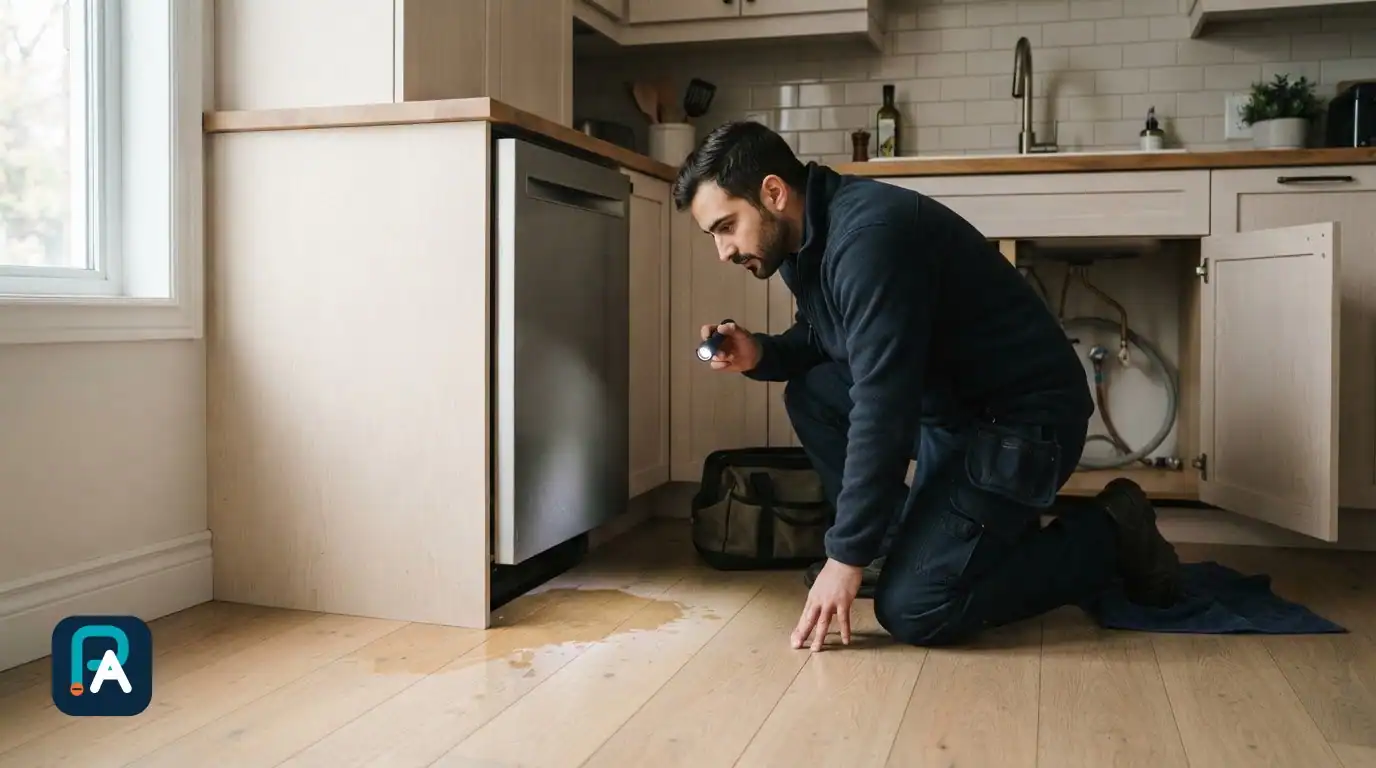
Water under a dishwasher may come from its water supply, its drain or the appliance itself. It may also start at the kitchen sink or a nearby connection, travel beneath the cabinets and finally appear in front of the dishwasher. The position of the puddle alone does not identify the leaking part.
The time you noticed the water, its visible path and any symptoms shown by the dishwasher can help narrow the possibilities. They do not justify running another cycle to see whether the leak returns, pulling out the machine or opening a panel. If water is still spreading or is close to electrical equipment, stop using the appliance and follow the initial guidance for an active water leak. This guide addresses the more specific question of where water already found under or in front of a dishwasher might have started.
Key takeaways
- Water in front of the door may have travelled from the back of the dishwasher or the cabinet beneath the sink.
- Water noticed around filling, washing or draining points to different paths, although the timing alone cannot establish a cause.
- An obstruction at the door, unusual suds, the load and the appliance’s position can matter when water escapes at the front.
- Water left inside the tub and water on the kitchen floor are separate observations that may occur together.
- A leak warning or error code reports what a particular model detected; it does not automatically identify a part to replace.
- The safest useful clues come from areas already accessible while the appliance is off, without handling connections.
Table of contents
- Which water paths should you distinguish around a dishwasher?
- What can the timing of the water tell you?
- Why might water appear near the door?
- What can the cabinet beneath the sink reveal?
- Does poor draining necessarily explain a puddle?
- What does a leak light or error code mean?
- How can you prepare for an assessment and protect the surroundings?
- Frequently asked questions
Which water paths should you distinguish around a dishwasher?
A dishwasher takes water in through a supply connection, circulates it inside the tub and sends it away through a drain hose. Thinking about these three paths prevents a common assumption: that every puddle at the base of the machine comes through the door. The point where water reaches the floor may be some distance from where it escaped. It can run along a hose, pass through a cabinet opening or follow the slope beneath the flooring.
The supply path brings pressurized water to the appliance. Depending on the installation, part of the line and a shutoff valve may be inside the cabinet beneath the sink, with other components hidden behind the dishwasher. Dampness in that cabinet that persists while the machine is idle could involve a supply connection. The kitchen faucet or another line in the same cabinet is also possible. Proximity to the dishwasher is a clue, not proof.
The drain path carries used water to a drainage connection, often in the neighbouring cabinet. Visible dampness around this route is useful to report, especially if it was discovered after a completed cycle. The hose, the fitting where it joins the drain and the sink drain are different components. Without seeing the entire route, a puddle cannot confidently be attributed to one of them. The installation requirements also depend on the particular appliance and drain arrangement.
The machine itself includes the door, tub and internal filling, circulation and pumping components. Water escaping at the front may relate to the door’s seal or closure, excessive foam, loading that interferes with closing, or how the unit sits in its opening. Water appearing from beneath it could come from a hidden component. Electrolux Canada’s dishwasher leak guidance discusses several distinct possibilities, including the drain hose, water supply hose, door closure, filter and detergent. Those are possibilities to compare with the observations, not a checklist that identifies the failure in every brand.
There is a fourth area to keep in mind: the rest of the kitchen. A sink, faucet, refrigerator water line or another connected appliance may wet the same stretch of floor. A cabinet that looks dry when you inspect it may have been wet earlier, before water moved or evaporated. Record a plausible sequence without creating a new test by running the dishwasher again.
What can the timing of the water tell you?
A short note made when the water is found is more useful than trying to reconstruct several previous washes. Was the floor already wet before a cycle began? Did you actually see the water appear while the appliance was filling, washing or draining? Was it discovered immediately afterward or the next morning? Was the sink in use around the same time? These details sort the possibilities; they do not diagnose a particular part from a distance.
If water is present while the dishwasher is idle, consider a source beyond the drain pump. Its supply line may remain pressurized between cycles. The sink may have been used, or water may be moving through the cabinet from another fixture. If the wet area is growing even though the dishwasher is off, containing the active leak takes priority over watching for more clues. Only close a valve that you can identify and reach safely. The separate guide to the main water shutoff valve explains how a shutoff is identified and what it may isolate.
Water first noticed near the start of a cycle might direct attention to filling or to a condition that lets water escape from the tub. Water noticed during washing might suggest the door, suds or an internal part. A trace observed when the unit drains makes the drain hose and its connection worth mentioning. These are associations, not reliable timing tests. A dishwasher can fill and drain more than once, and a leak at the back may take time to emerge at the front edge of the floor.
A puddle found after the cycle has ended does not mean the leak happened at the end. Cabinet materials or flooring can absorb water and release it slowly. Opening a wet door can also let a few drops fall from the door or dishes. Ask whether the amount and path of water really fit those drops. A recurring puddle, swelling cabinet panel or damp baseboard should not be dismissed on that basis.
Do not run a fresh cycle just to synchronize the leak with a program stage. Write down the cycle that had been used, the approximate time, other kitchen activity and any surfaces you know remained dry. This timeline can guide the later examination of the plumbing or appliance without introducing more water into the building.
Why might water appear near the door?
When the first visible trace is clearly at the front, the door deserves attention, though the gasket is not automatically at fault. A utensil projecting from a rack, a poorly positioned basket or residue at the closure can interfere with the seal. A door may also be misaligned, or the appliance may sit unevenly. A newly installed kick plate can sometimes interfere with closing; Electrolux Canada notes door closure among its leak checks. The installation and owner’s instructions for the actual model matter here.
Foam is another useful clue. Hand dishwashing liquid behaves differently from detergent intended for a dishwasher. Too much dishwasher detergent or spilled rinse aid can also produce unusual suds. Electrolux lists those circumstances as potential contributors to leaking. If you know a different product was used or rinse aid spilled, record that fact. It would not, by itself, explain water that keeps appearing while the dishwasher is idle.
The appearance of the water offers limited information. Visible bubbles at the front may make suds escaping during washing more plausible than a continuous clear drip near a supply connection. Yet water can pick up residue as it crosses a cabinet or floor. Colour and smell alone cannot distinguish tub water from a leaking fitting. Do not taste the water, and avoid contact if it may be contaminated.
If the appliance is off and the door area is dry and accessible, a look from outside may reveal a visible obstruction or obvious misalignment. Do not remove the inner door, toe panel or gasket to prove a theory. A new gasket would not fix a leak behind the machine, while a new fitting beneath the sink would not fix a door that fails to close. Identify the model and consult its instructions before anyone works on the appliance.
What can the cabinet beneath the sink reveal?
In many kitchens, the dishwasher’s connections share the service area beneath the sink. Its supply line and drain hose may pass through the side of that cabinet, though the layout varies. If you can open the cabinet from a dry, safe area, examine only what is visible: the cabinet floor, the opening where hoses pass through, the area around the sink trap and the floor near the cabinet base. Do not move hoses aside or touch fittings to feel for a drip.
A trace near a valve or supply line raises a different question from a trace around the drain connection. The first may involve water entering the appliance; the second may involve water leaving it. However, a faucet leaking at its base can wet the cabinet and then follow an otherwise sound hose downward. A photo that includes neighbouring fittings and the surrounding cabinet gives more context than a close-up of a drop. It still cannot, on its own, prove which part is leaking.
Sink use is relevant. If the puddle appeared after washing dishes by hand and the dishwasher had not run, say so. If both were used, the source remains uncertain. A slow kitchen drain can cause symptoms near the dishwasher’s drain connection, but it does not prove that the appliance hose is split. A sink that drains slowly or backs up is a separate drainage concern; it should be described as such before someone replaces a dishwasher part.
Recent changes to the dishwasher, garbage disposal, counter or plumbing in the cabinet also provide context. A connection may have been remade, a hose moved, or a toe panel may now impede the door. That history alone does not establish improper installation. Compare the actual arrangement with the manufacturer’s instructions for that model. Electrolux Canada’s drain hose guide illustrates why the route and connection matter. Its specified measurements should not be copied to a different machine without checking that machine’s own manual.
Avoid tightening a damp connection “just a little” as an experiment. Excess force can damage a fitting, and a pressurized line should not be taken apart on a guess. The value of observing the cabinet is to describe which area needs examination and whether the work may concern visible plumbing, the drain connection or the inside of the appliance.
Does poor draining necessarily explain a puddle?
No. Water remaining in the tub after a program first raises the question of why the appliance did not drain as expected. Water on the floor means some water left the appliance or another kitchen component. The two symptoms can be related, but one does not establish the other.
Depending on the model, debris in a filter, a pump problem or an obstructed drain route can contribute to incomplete draining. Whirlpool Canada describes the filter and other possible causes of standing water in the machine. A dishwasher that drains poorly does not necessarily discharge water onto the floor; there must also be a route for it to escape, or another source of the puddle. Conversely, a supply connection could leak while the tub drains normally.
Once the appliance is stopped, note only what is already visible. Is there an unusual amount of water in the tub, a drain warning, moisture in the sink cabinet, or a trace confined to the front of the door? Do not put a hand into dirty standing water that may contain broken glass. If your model’s manual permits a filter check, and the area is dry and safe, use its instructions. Even a dirty filter would not automatically explain a puddle outside the machine.
“It’s the drain” can be an expensive shortcut. A blocked kitchen sink, a drain hose installed outside its specified route, a leak at a fitting and a failed appliance pump call for different work. Describe water retained in the tub, the condition of the sink and where water emerges from the cabinet or appliance as separate observations. This helps avoid requesting drain cleaning when the real concern may be a supply connection or the door.
What does a leak light or error code mean?
Some dishwashers have a water sensor in their base, a leak code or a program that stops after an alert. Record the exact message together with the brand and model. A code has a model-specific meaning. It may indicate moisture detected inside the appliance without identifying the component that released it; a different message might concern drainage or water level.
For example, Bosch Canada says its E15 code means a safety switch detected water in the base of the dishwasher and its leakage protection was activated. Bosch instructs owners to turn off the water inflow and contact its support team. Samsung Canada’s code guide lists LC and LE as leakage codes, with nuances for some Waterwall models, while its over-level codes refer to a different problem. Similar letters should never be assumed to have the same meaning on another brand.
No warning does not rule out a leak. An internal sensor may watch only part of a machine. On one specified Whirlpool model, the manufacturer states that its leak identification system does not detect leaks from water inlet or tub drain connections and hoses, or leaks due to cracked tubs or doors. That limitation belongs to the named model; check your own manual rather than generalizing it to every dishwasher. If water is actually on the floor, a silent display cannot settle the matter.
Photograph the message if it is still shown, then consult the manual for the exact model number. Avoid repeated resets or trial cycles while the source of water is unexplained. An alert built into the dishwasher addresses a different question from choosing a water leak detector for the home. That separate guide covers sensor placement, notifications and automatic shutoffs; the built-in warning does not trace this particular puddle.
How can you prepare for an assessment and protect the surroundings?
Start with safety. If water touches or threatens an outlet, cord or electrical component, stay out of the wet area and do not handle the appliance. Hydro-Québec’s guidance on water damage near electrical installations explains the hazard. If water is continuing to escape, stop using the dishwasher and have the appropriate water supply isolated when it can be done safely. Do not cross standing water to reach a valve or electrical panel.
From a dry, accessible place, collect four practical details: where water was first seen, when it was found, what other fixtures or appliances had been used and any symptoms shown by the dishwasher. If safe, photograph the wider view of the dishwasher and open sink cabinet, then the visible trace. A tight shot of a puddle says less than one that shows the door, cabinet and floor together. Keep the brand and model number available so the correct manual and code meanings can be checked.
Those details help determine who should assess which area. Moisture at a visible supply fitting, valve or sink drain connection points toward a plumbing assessment. A door that does not close properly, a machine-specific error code or water apparently coming from a hidden internal component may call for the manufacturer or an appliance specialist. The two areas can meet at the installation connections. Describe the evidence instead of choosing a replacement part in advance. For an active plumbing leak, the service page linked at the beginning explains the response route.
Also consider where the water went after leaving its source. A small leak inside a cabinet may wet the back panel, toe kick, subfloor or a ceiling below without making a large puddle. Health Canada advises fixing damp spots and water leaks promptly. Fixing the connection or appliance does not automatically dry affected building materials. Report swollen surfaces, a persistent odour or dampness that remains after the leak is corrected so the condition of the surrounding materials can be assessed separately.
Finally, do not write off the entire dishwasher because of a puddle, and do not put it back into service just because the visible floor has dried. Identify the most plausible water path, be clear about what cannot be seen and have the source checked before another cycle. That approach reduces guesswork and the chance of wetting the cabinetry again.
Frequently asked questions
Are a few drops after opening the door a leak?
Water can fall from a wet dish or the door when the machine is opened. Note whether the drops appeared precisely then and whether the floor was dry beforehand. A puddle that was already present, dampness beneath the toe kick or swelling cabinetry is not explained simply by those drops. Do not rerun a cycle to make the comparison if a leak is suspected.
Can the bottom of the cabinet be damp without a puddle in front of the machine?
Yes. A cabinet panel, toe kick or subfloor can hold moisture and hide its path. Photograph the accessible areas and report warping or a lasting odour. Do not pull off a toe kick to determine the source yourself. The immediate questions are whether more water is entering and whether the materials need assessment after the source is fixed.
Could a nearby refrigerator leak look like a dishwasher leak?
Yes, especially if the refrigerator has a water connection. Water can move along a sloped floor and beneath cabinets before emerging by the dishwasher. Mention which neighbouring appliances have water lines, without moving them or handling their connections. The position of a puddle alone cannot distinguish between these sources.
Does the valve beneath the sink always shut off only the dishwasher?
No. The layout depends on the installation. A valve might isolate one branch or affect more than one fixture. Its location near a hose does not establish what it controls. If you cannot identify it, do not force the handle as a test. Share its photo and location with the person arranging a safe shutoff, especially where other occupants may be affected.
Should I keep the model number after a leak?
Yes. It leads to the correct manual, the exact meaning of a displayed code and the installation instructions for that appliance. Also record the serial number if the manufacturer needs it for service, and the installation date if known. These details are more reliable than searching by the appearance of the door.
Does a dried water mark mean the problem is over?
Not necessarily. An intermittent leak may appear only under certain conditions, and a cabinet panel may remain damp after the visible floor dries. Keep the appliance out of use until the source has been identified and checked. If water reappears without a dishwasher cycle, report that observation so the supply and neighbouring fixtures are considered.
Water under a dishwasher is a question about the path water took. Record what was in use, which surfaces are wet and which parts remain hidden. Keep the dishwasher off until the source is understood. The assessment can then focus on the right connection, drain route or appliance component while also checking whether the cabinet and floor retained moisture.